
Report overview
In the Federal Reserve's 2025 SHED (fielded October 2025), 16% of all U.S. adults said they used buy now, pay later (BNPL) in the prior 12 months, and 26% of those BNPL users said they paid at least one installment late. Both shares are the highest of the five survey waves since the question began in 2021, when they were 10% of adults and 15% of users (Federal Reserve SHED 2025; SHED 2021). The usage question was reworded in 2023, so the 2021-2022 and 2023-2025 figures are not strictly comparable.
ComplexSearch also modeled what overlapping pay-in-4 loans do to a paycheck. In this scenario, four $142 pay-in-4 purchases made on consecutive biweekly paydays put an installment on 7 straight paychecks. The largest of those debits is $142, or 9.5% of a stated $1,500 biweekly paycheck. The same four purchases on a credit card paid in full put $284 to $426 (18.9% to 28.4%) on a single paycheck, depending on the statement date. This is a scenario, not observed household data. $142 is the CFPB's average BNPL purchase for 2022.
Who uses BNPL: Federal Reserve SHED, 2021-2025
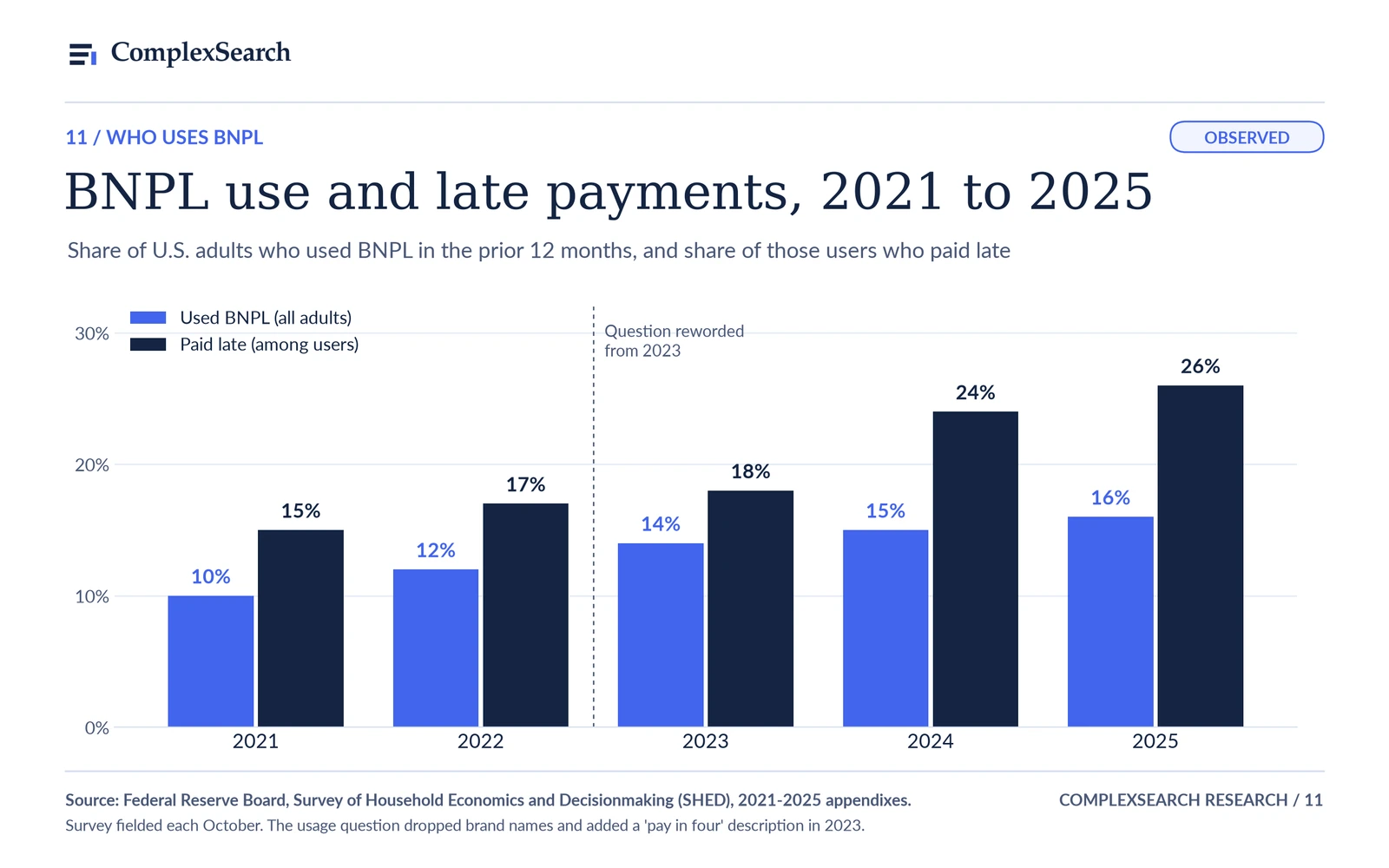
The question was reworded in 2023, so the earlier usage series should not be directly compared.
Source: Federal Reserve SHED · Direct link
The Survey of Household Economics and Decisionmaking (SHED) is fielded each October to about 11,000 to 13,000 U.S. adults. The figures below are weighted shares from the published appendixes.
| Survey year (fielded October) | Used BNPL, prior 12 months (all adults) | Paid late (among users) | Charged a fee or extra amount (among late payers) | Unweighted n, all adults |
|---|---|---|---|---|
| 2021 | 10% | 15% | not asked | 11,874 |
| 2022 | 12% | 17% | 55% | 11,667 |
| 2023 | 14% | 18% | 59% | 11,400 |
| 2024 | 15% | 24% | 57% | 12,295 |
| 2025 | 16% | 26% | 64% | 12,934 |
Sources: SHED appendixes for 2021, 2022, 2023, 2024 and 2025 (questions BNPL1, BNPL3, BNPL3A). Evidence: observed.
Question changes matter for the trend:
- In 2021 and 2022, BNPL1 named Affirm, Klarna and Afterpay and described a service that "lets you make payments over time." From 2023, the question dropped brand names and described paying part of the price upfront and the rest in installments, such as "pay in four."
- BNPL2 (number of purchases still being repaid) was asked only in 2021 and 2022. In 2022, 25% of users had none outstanding, 35% had one, 22% had two and 18% had three or more (SHED 2022 appendix).
- 2025 added a single "main reason" question (BNPL5), an overdraft question (BNPL1A), purchase types (BNPL6) and credit-reporting beliefs (BNPL7). Earlier years asked users to pick all reasons that applied, so main-reason shares have no earlier comparison.
In SHED 2025, 31% of BNPL users said their main reason was to spread out payments, 29% said it was the only way they could afford the purchase, 16% wanted to avoid interest charges and 12% cited convenience (Federal Reserve, Economic Well-Being of U.S. Households in 2025: Credit). Among BNPL users with family income under $25,000, 40% said BNPL was the only way they could afford the purchase (SHED 2025 report). The appendix version of this question (n = 1,935) shows 32% and 30% for the first two reasons. This report uses the report table, which also gives the income breakdown.
In SHED 2025, BNPL use as a share of adults in each family-income group was 18% under $25,000, 23% at $25,000-$49,999, 18% at $50,000-$99,999 and 12% at $100,000 or more. Late payment as a share of BNPL users in those groups was 40%, 33%, 25% and 11% (SHED 2025 report).
The Fed reports that a BNPL payment caused an overdraft or insufficient-funds fee for 11% of all BNPL users in SHED 2025. The underlying question was asked only of BNPL users who had paid an overdraft fee in the past year (n = 542), and 39% of that subgroup said yes; the two percentages have different denominators (SHED 2025 appendix). The most common SHED 2025 purchase types were clothing (49% of BNPL users), electronics (32%), furniture (26%), groceries (20%), travel (19%) and medical or veterinary procedures (8%), with users selecting all that applied (SHED 2025 appendix).
The 2025 report text says use rose to 16% "up from 15 percent in 2025." The 15% figure is the 2024 survey.
Loan volume and loan stacking: CFPB lender data
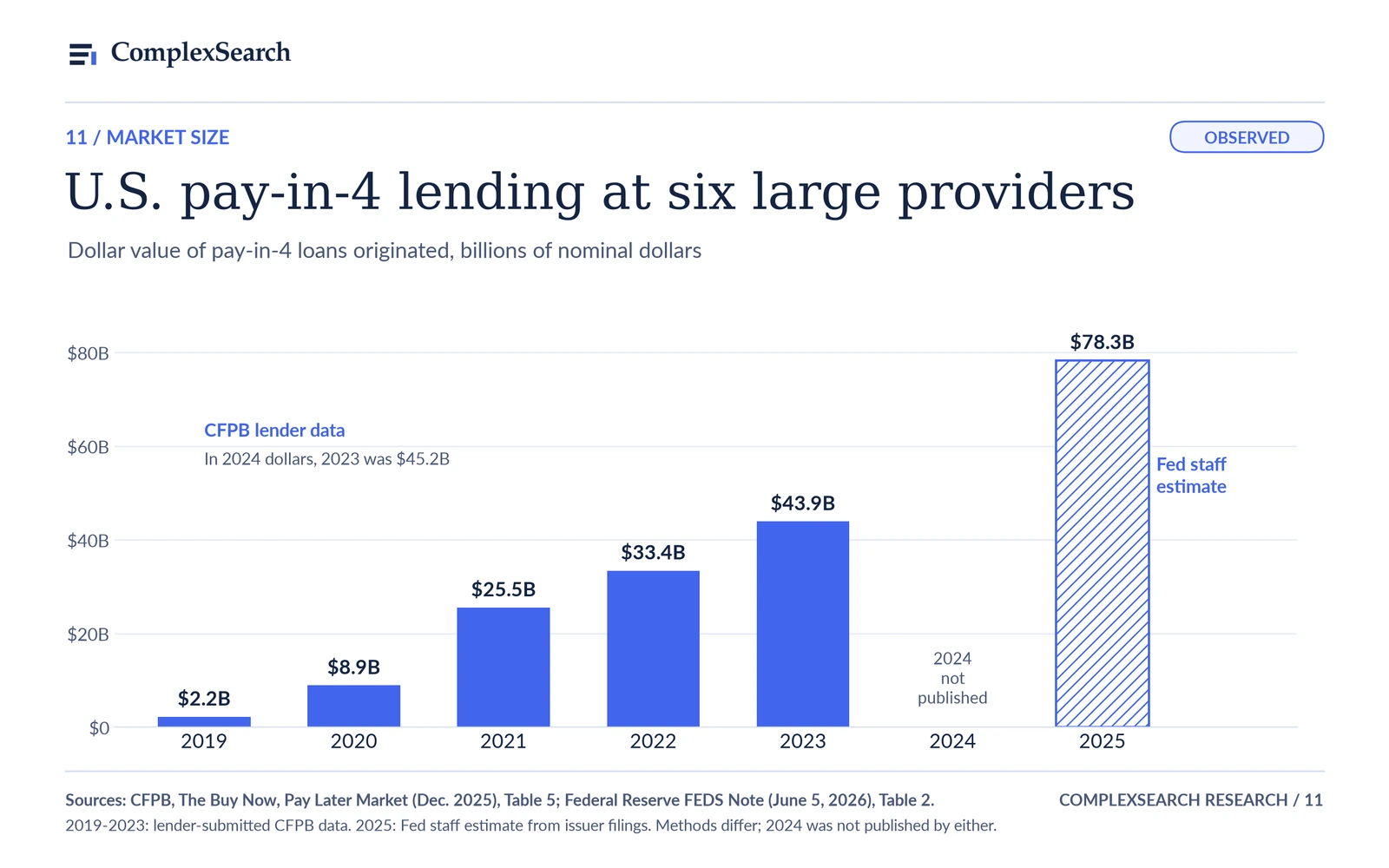
The reporting lender panel is not a census of BNPL.
Source: CFPB lender data · Direct link
The CFPB's December 2025 market report covers pay-in-4 loans at six large lenders (Affirm, Afterpay, Klarna, PayPal, Sezzle and research dataset). The CFPB estimates these lenders made about 40% of U.S. point-of-sale financing (CFPB, The Buy Now, Pay Later Market, Dec. 2025).
| Year | Loans originated | Dollar originations, nominal | Dollar originations, 2024 dollars |
|---|---|---|---|
| 2019 | 19.8 million | $2.2 billion | $2.7 billion |
| 2020 | 77.9 million | $8.9 billion | $10.8 billion |
| 2021 | 196.6 million | $25.5 billion | $29.5 billion |
| 2022 | 273.8 million | $33.4 billion | $35.8 billion |
| 2023 | 335.8 million | $43.9 billion | $45.2 billion |
Source: CFPB, Dec. 2025. Evidence: observed.
The same report puts the average 2023 loan at $135 in 2024 dollars. User counts summed across the six lenders rose from 48.0 million in 2022 to 53.6 million in 2023, which overcounts people who borrowed from more than one lender. Each lender's users averaged 6.3 loans and $848 (2024 dollars) in 2023, up from 5.7 loans and $745 in 2022. 4.1% of 2023 loans were charged a late fee, down from 7.0% in 2019, and the average fee was $9.99 in 2024 dollars. The loan charge-off rate was 1.83% in 2023, down from 2.63% in 2022 (CFPB, Dec. 2025).
The CFPB's January 2025 report links lender data to credit records for 2022. 21.2% of consumers with a credit record used BNPL in 2022, up from 17.6% in 2021. That denominator (consumers with a credit record, from lender data) differs from SHED's (all adults, self-reported), so the two shares should not be compared directly. The average transaction was $142 and the median was $108 (September 2024 dollars). 62.7% of borrowers had more than one BNPL loan outstanding at the same time, meaning another loan was originated within 42 days, and 32.6% had simultaneous loans at different lenders. Borrowers averaged 9.5 originations a year (median 4), with an average of 44.8 days between loans (median 29.3). The average borrower had 1.1 active loans on any given day. About 20% of borrowers took out more than 12 loans in the year (CFPB, Jan. 2025).
Earlier CFPB data: in its Making Ends Meet survey, 17% of consumers had used BNPL in the year to February 2022. Below-prime BNPL users who revolve card balances would face card APRs of about 19% to 23% (CFPB, Mar. 2023). In 2021, five lenders made 180 million loans worth $24.2 billion (CFPB, Sept. 2022).
2025 market estimate: Federal Reserve staff
A June 5, 2026 FEDS Note estimates that six providers issued $156.7 billion of BNPL credit in the U.S. in 2025, across all products. Pay-in-4 was $78.3 billion of that (50%), and 63% of the total carried a 0% APR (FEDS Notes, June 5, 2026). The estimate comes from issuer disclosures, not the CFPB's lender data, so it should not be read as a continuation of the CFPB series in Figure 2.
Provider filings
Provider figures below come only from SEC filings. They mix products and geographies, so they are not comparable to each other or to the CFPB series.
| Issuer | Filing | Metric | Value |
|---|---|---|---|
| Affirm | 10-K, FY ended June 30, 2026 | GMV, all products and markets | $50.2B (FY2025: $36.7B; FY2024: $26.6B) |
| Affirm | same | Pay-in-X share of GMV | 16% (about $8.0B, derived) |
| Affirm | same | Interest-bearing loans, share of GMV | 70% |
| Affirm | same | Active consumers; transactions per active consumer | 27.8 million; 7.0 |
| Affirm | same | Late fees charged | $0 |
| Klarna | 20-F, 2025 | GMV, global, all products | $127.9B (2024: $105.0B; 2023: $92.5B) |
| Klarna | same | U.S. share of GMV | 21% (about $26.9B, derived) |
| Klarna | same | Active consumers, global (includes app log-ins) | 118 million |
| Sezzle | 10-K, 2025 | GMV, U.S. and Canada | $3.94B (2024: $2.54B) |
| Sezzle | same | Active consumers | 3.05 million |
Evidence: observed, except the two rows marked derived (filing total multiplied by the rounded share in the filing). Klarna's filing describes Pay in 4 as installments "paid every 14 days," and Sezzle's describes 25% upfront and the rest every two weeks over six weeks. The scenario below uses that schedule.
ComplexSearch scenario: stacked pay-in-4 loans and a paycheck
All figures in this section are ComplexSearch modeled cash flows, not observed household data.
Setup
- One household is paid $1,500 every 14 days. That is about $39,000 a year, inside the SHED $25,000-$49,999 family-income band, where 23% of adults in that band used BNPL (SHED 2025).
- Each purchase is $142, the CFPB's 2022 average BNPL transaction.
- Pay-in-4: 25% is due at purchase, then 25% on days 14, 28 and 42. There are no fees, refunds or missed payments.
- The household makes 1 to 4 purchases. The first is on a payday (day 0), and later purchases follow at a fixed interval of 7, 14, 21, 28 or 42 days. Each debit is charged to the paycheck covering the day it falls on.
- Regulation: the scenario does not depend on any federal BNPL rule. It assumes lender terms as described in the issuer filings above (four interest-free installments, no fees when paid on time). ComplexSearch did not review the current status of federal BNPL regulation for this report, so nothing here should be read as a statement about which rules apply.
- Card comparison: the same purchases go on a credit card that is paid in full. The statement closes on day 15 and every 30 days after that, and payment is due 25 days after the close. The full statement balance comes out of the paycheck covering the due date. No interest is charged inside the grace period.
Base case: four purchases, one every 14 days
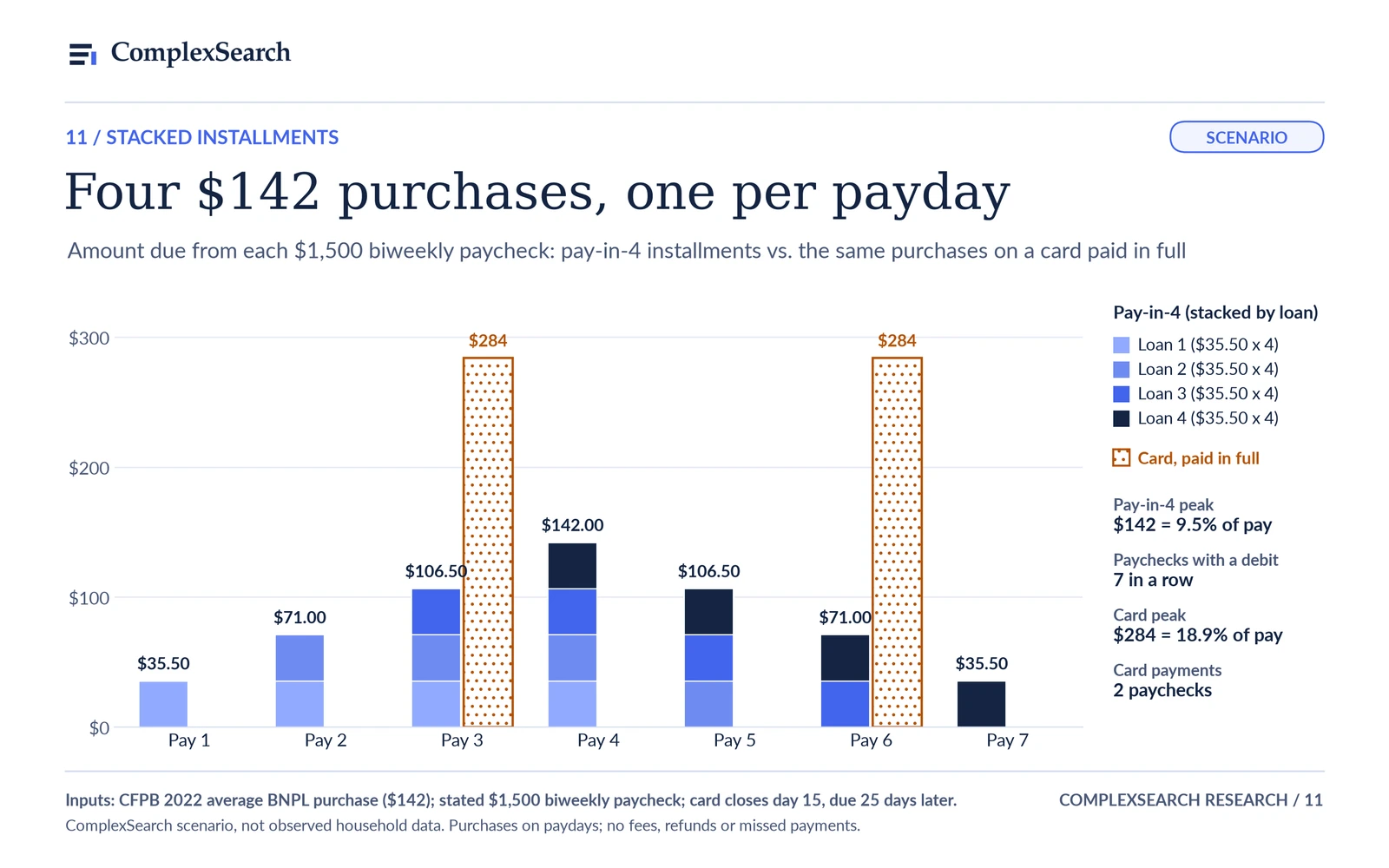
This cash-flow example is a scenario, not an estimate of typical household behavior.
Source: ComplexSearch scenario inputs and outputs · Direct link
| Paycheck | 1 | 2 | 3 | 4 | 5 | 6 | 7 |
|---|---|---|---|---|---|---|---|
| Pay-in-4 debits | $35.50 | $71.00 | $106.50 | $142.00 | $106.50 | $71.00 | $35.50 |
| Card paid in full | $0 | $0 | $284 | $0 | $0 | $284 | $0 |
Pay-in-4 debits land on 7 consecutive paychecks and peak at $142 (9.5% of pay) on paycheck 4, when one installment from each of the four loans is due. Up to $213 of scheduled installments is outstanding at once. The card concentrates the same $568 into two payments of $284 (18.9% of pay). On BNPL the debits are spread out but the obligation lasts longer. On the card, each payment is larger but less frequent.
For an already-revolving card balance with no grace period, repaid on the same four-installment schedule at the Fed's 22.36% APR for accounts assessed interest (2026 Q3, preliminary), the four purchases would cost $7.34 in interest (Federal Reserve G.19). Report #14 covers card interest costs in detail.
Sensitivity: number of loans and spacing
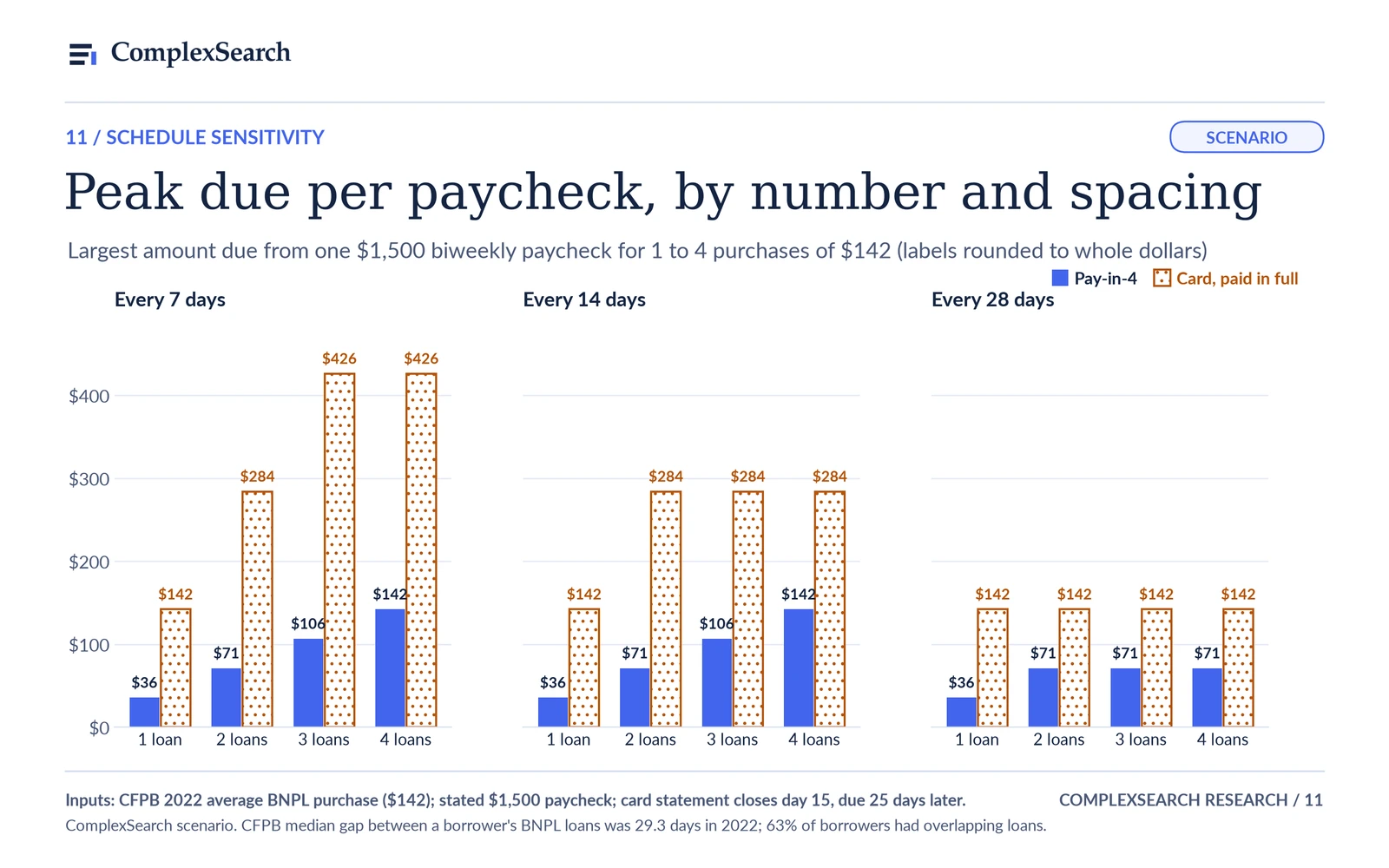
Hold other model assumptions fixed when comparing cells.
Source: ComplexSearch sensitivity analysis · Direct link
Peak amount due from one $1,500 paycheck ($142 purchases):
| Loans | Spacing (days) | Pay-in-4 peak | Share of pay | Paychecks with a BNPL debit | Card paid-in-full peak | Share of pay |
|---|---|---|---|---|---|---|
| 1 | any | $35.50 | 2.4% | 4 | $142 | 9.5% |
| 2 | 7 | $71.00 | 4.7% | 4 | $284 | 18.9% |
| 3 | 7 | $106.50 | 7.1% | 5 | $426 | 28.4% |
| 4 | 7 | $142.00 | 9.5% | 5 | $426 | 28.4% |
| 2 | 14 | $71.00 | 4.7% | 5 | $284 | 18.9% |
| 3 | 14 | $106.50 | 7.1% | 6 | $284 | 18.9% |
| 4 | 14 | $142.00 | 9.5% | 7 | $284 | 18.9% |
| 3 | 21 | $106.50 | 7.1% | n/a | $284 | 18.9% |
| 4 | 21 | $106.50 | 7.1% | n/a | $284 | 18.9% |
| 2 | 28 | $71.00 | 4.7% | 6 | $142 | 9.5% |
| 3 | 28 | $71.00 | 4.7% | 8 | $142 | 9.5% |
| 4 | 28 | $71.00 | 4.7% | 10 | $142 | 9.5% |
| 4 | 42 | $71.00 | 4.7% | n/a | $142 | 9.5% |
Paycheck counts are reported in the research materials for 7-, 14- and 28-day spacing only. The 21- and 42-day peaks come from the research materials.
When loans are at least 28 days apart, no more than two installments ever share a paycheck. The CFPB's 2022 median gap between a borrower's loans was 29.3 days. With 7- or 14-day spacing, BNPL peaks rise with each added loan.
Sensitivity: purchase size and paycheck
Four loans, every 14 days. The pay-in-4 peak equals one purchase price, and the card paid-in-full peak equals two purchase prices.
| Purchase | Pay-in-4 peak, % of $1,000 / $1,500 / $2,000 / $2,464 paycheck | Card peak, % of same paychecks |
|---|---|---|
| $108 (CFPB 2022 median) | 10.8% / 7.2% / 5.4% / 4.4% | 21.6% / 14.4% / 10.8% / 8.8% |
| $142 (CFPB 2022 average) | 14.2% / 9.5% / 7.1% / 5.8% | 28.4% / 18.9% / 14.2% / 11.5% |
| $250 | 25.0% / 16.7% / 12.5% / 10.2% | 50.0% / 33.3% / 25.0% / 20.3% |
| $500 | 50.0% / 33.3% / 25.0% / 20.3% | 100.0% / 66.7% / 50.0% / 40.6% |
| $1,000 | 100.0% / 66.7% / 50.0% / 40.6% | 200.0% / 133.3% / 100.0% / 81.2% |
$2,464 is two weeks of the BLS median usual weekly earnings for full-time workers, $1,232 in 2026 Q3, before taxes (BLS). The other paychecks are stated values.
Sensitivity: card statement date and APR
The card peak in the base case is $284 (18.9%) for statement close days 5 through 25. It is $426 (28.4%) when the statement closes on day 30, because three purchases fall into one cycle. The pay-in-4 peak stays at $142 for all close days. For the single revolver line, interest on the four purchases is $6.23 at 19% APR, $6.95 at 21.19%, $7.34 at 22.36%, $7.55 at 23% and $9.85 at 29.99%.
Methodology
the research materials reads source files saved in raw/ and extracts each figure with text patterns. Rerunning with --download fetches the files again. The script then writes the observed research datasets and runs the scenario. SHED figures come from the published appendix tables, not the microdata. Provider figures come from each issuer's latest annual filing on SEC EDGAR. Values derived from provider figures multiply a reported total by a reported share. The scenario is a deterministic day-by-day schedule over 20 pay periods. Every formula is listed in the research materials. the research materials draws the figures from the CSVs.
Limitations
- SHED measures self-reported use in the prior 12 months. The 2023 question rewording may account for part of the 2022-2023 increase.
- CFPB lender data covers six lenders and pay-in-4 only, and stops at 2023. User counts are summed across lenders. The January 2025 credit-record findings describe 2022.
- The 2025 Fed staff estimate uses a different method and a different set of providers. It is not a measured continuation of the CFPB series. No source in this report gives a 2024 U.S. pay-in-4 total on either basis.
- Provider GMV includes interest-bearing loans, pay-in-full and non-U.S. volume, depending on the issuer.
- The scenario assumes on-time payments, fixed purchase timing starting on a payday, a fixed card statement cycle and one paycheck as the only funding source. It omits late fees, overdraft fees, rewards, refunds, other bills and pay-in-4 loans that are not on a 14-day schedule. Results describe the timing of payments, not affordability for any actual household.
- The BLS site blocks scripted downloads. The $1,232 median was transcribed from the public release page, and
the research materialsholds only the access-denied response, sothe research materialscannot check that figure against a saved copy. It is used only to set one sensitivity paycheck ($2,464); the base case does not depend on it.
Download the report
Get the complete report, including charts, methodology and linked sources.
How to cite
ComplexSearch Research. Buy Now, Pay Later Statistics. November 2026.
To include a linked citation on your site, paste this snippet into an HTML block or your editor’s source view.