
Report overview
In a ComplexSearch model, a $5,000 credit card balance repaid only with an illustrative minimum-payment rule (1% of the balance plus interest, $40 floor) takes 185 months (15.4 years) and costs $7,673 in interest at 22.36%, the Federal Reserve's average rate on U.S. commercial-bank card accounts assessed interest in its August 2026 survey (preliminary) (Federal Reserve G.19). Holding the first $144 payment fixed instead cuts the cost to 57 months and $3,179. The model assumes no new purchases, fees or rate changes. The $40 floor is the most common minimum-payment floor in a 2025 CFPB review of 21 issuers' card agreements (CFPB, The Consumer Credit Card Market, 2025).
The rate behind that model is near a record relative to the prime rate. In August 2026, the G.19 rate on accounts assessed interest was 15.61 percentage points above the bank prime rate of 6.75%. That spread is the widest in the quarterly data since November 1994. The spread is a ComplexSearch calculation from two Federal Reserve series.
Card interest rates: Federal Reserve G.19
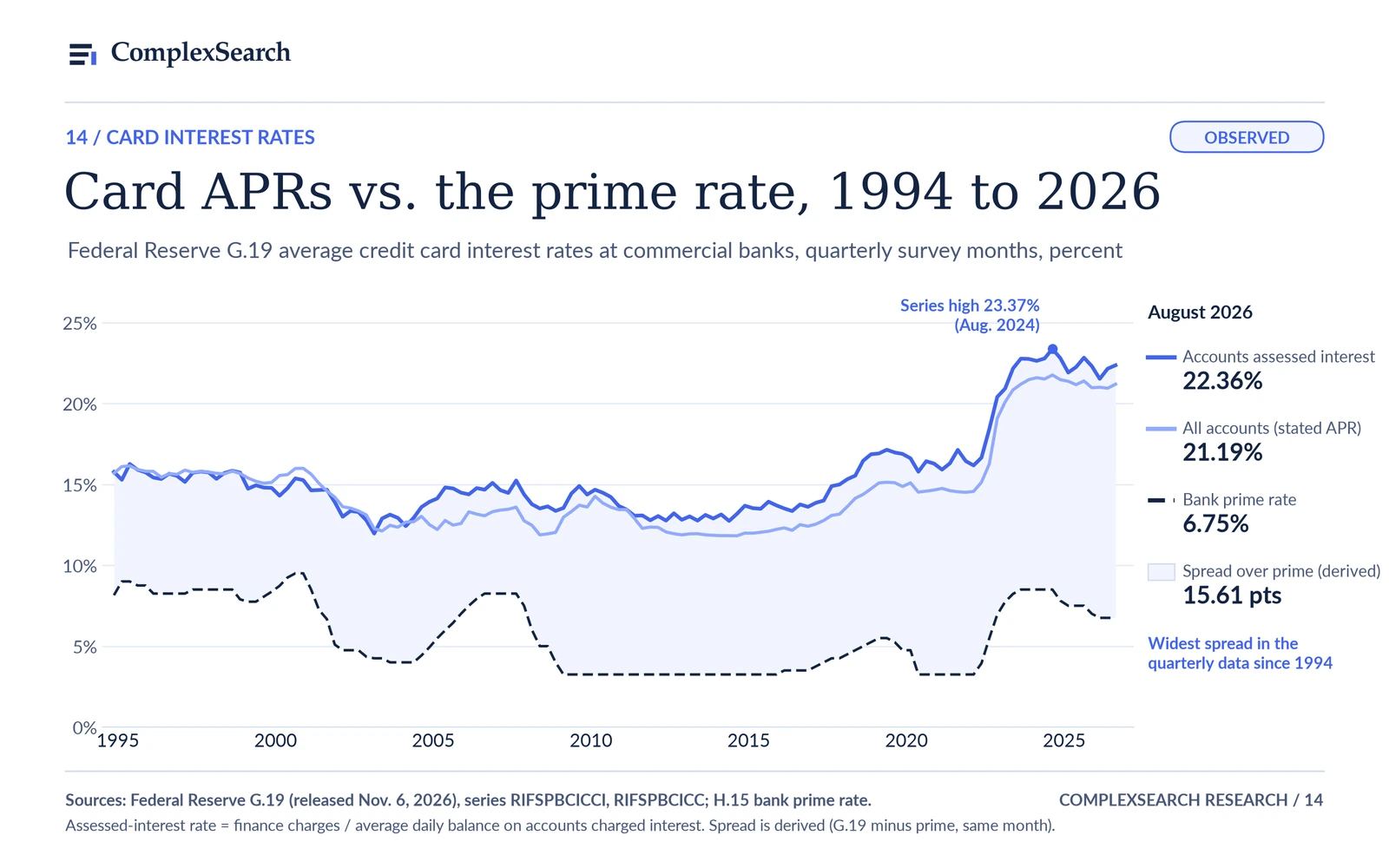
The spread compares aggregate series. It is not an issuer’s profit margin.
Source: Federal Reserve G.19; prime series in the research package · Direct link
The Federal Reserve publishes two credit card rates each quarter in its G.19 Consumer Credit release. Both come from the FR 2835a survey of commercial banks and are measured in the middle month of the quarter (February, May, August, November) (G.19 About).
- All accounts: the stated purchase APR, averaged across all accounts whether or not they carry a balance.
- Accounts assessed interest: annualized finance charges divided by average daily balances, for accounts that were charged interest. This is the closer measure of what revolvers pay.
| Survey month | All accounts | Accounts assessed interest | Bank prime rate | Spread, assessed minus prime (derived) |
|---|---|---|---|---|
| Aug. 2019 | 15.10% | 16.97% | 5.25% | 11.72 pts |
| Aug. 2020 | 14.58% | 16.43% | 3.25% | 13.18 pts |
| Aug. 2021 | 14.54% | 17.13% | 3.25% | 13.88 pts |
| Aug. 2022 | 16.27% | 18.43% | 5.50% | 12.93 pts |
| Aug. 2023 | 21.19% | 22.77% | 8.50% | 14.27 pts |
| Aug. 2024 | 21.76% | 23.37% | 8.50% | 14.87 pts |
| Aug. 2025 | 21.39% | 22.83% | 7.50% | 15.33 pts |
| Feb. 2026 | 21.00% | 21.52% | 6.75% | 14.77 pts |
| May 2026 | 20.94% | 22.15% | 6.75% | 15.40 pts |
| Aug. 2026 | 21.19% | 22.36% | 6.75% | 15.61 pts |
Sources: Federal Reserve G.19, released November 6, 2026 (series RIFSPBCICC_N.M and RIFSPBCICCI_N.M, XML data); bank prime rate, monthly average, from Federal Reserve H.15. Evidence: observed, except the spread column (derived). The latest quarter is subject to revision.
- The rate on accounts assessed interest peaked at 23.37% in August 2024, the highest since the series began in November 1994. Its low was 11.96% in February 2003.
- The all-accounts rate peaked at 21.76% in August 2024. Its low was 11.82% in August 2014.
- The spread over prime was 7.62 points in November 1994 and reached its low of 5.52 points in May 2000. It has been above 14 points in every survey month since August 2023.
- G.19 rates cover commercial banks only and are not the same measure as the CFPB's APR margin, which is calculated at the account level from large-issuer data.
Balances and delinquency: New York Fed, 2026Q3
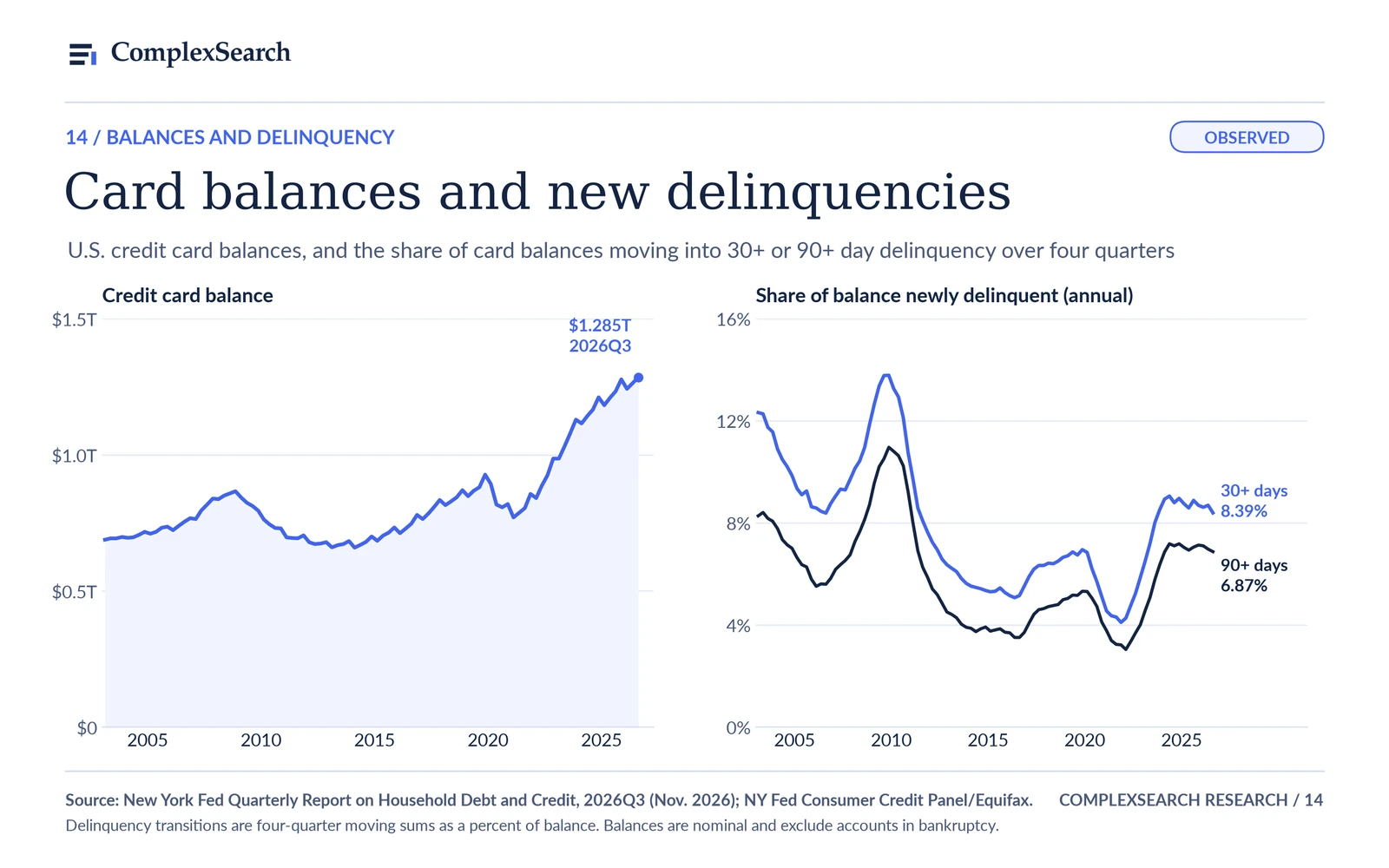
These metrics describe credit report balances, not the share of cardholders.
Source: New York Fed Household Debt and Credit · Direct link
The New York Fed's Quarterly Report on Household Debt and Credit uses the New York Fed Consumer Credit Panel, based on Equifax credit records (New York Fed HHDC).
| Measure (2026Q3 unless noted) | Value |
|---|---|
| Credit card balance | $1.285 trillion (up $22 billion, or 1.7%, from 2026Q2) |
| Credit card balance, 2025Q3 | $1.233 trillion |
| Credit card balance, 2019Q4 | $0.927 trillion |
| Aggregate card credit limit | $5.674 trillion (up $115 billion from 2026Q2) |
| Open card accounts | 660.83 million (accounts, not people) |
| Share of card balance 90+ days delinquent | 12.90% (12.41% in 2025Q3) |
| Balance transitioning into 30+ day delinquency, annualized | 8.39% (8.69% in 2026Q2; peak in recent cycle 9.05% in 2024Q2) |
| Balance transitioning into 90+ day delinquency, annualized | 6.87% (6.97% in 2026Q2; 7.18% in 2024Q2 and 2024Q4; 10.96% in 2009Q4) |
| Utilization, balance / limit (derived) | 22.6% |
| Balance per open account (derived) | $1,945 |
Sources: HHDC 2026Q3 data workbook and report, released November 2026. Evidence: observed, except rows marked derived. Transition rates are four-quarter moving sums, as a percent of balance. Balances are nominal.
Series change: from the 2026Q1 report, the credit score breakdowns on pages 6 to 9 use VantageScore 4.0 instead of the Equifax Risk Score 3.0. The report notes that the change slightly improved the score distribution for credit cards, so score-band shares before and after 2026Q1 are not directly comparable. This report does not use score-band figures.
Interest, fees and APR margins: CFPB
The CFPB's 2025 Consumer Credit Card Market Report, published December 30, 2025, covers data through 2024 from large issuers in the Federal Reserve's Y-14 data plus issuers that report to the CFPB (CFPB 2025 report; landing page).
| Measure | Value | Period |
|---|---|---|
| Interest charged to consumers | $160 billion | 2024 (up from $105 billion in 2022) |
| Fees charged to consumers | $31.3 billion | 2024 (up 23%) |
| Late fees | $17.0 billion | 2024 (up 17% since 2022) |
| Private label share of late fees | 34% ($5.8 billion), versus 7.5% of balances | 2024 |
| Deep subprime share of accounts / of late fees | 14% / 40% | 2024 |
| Average APR, general purpose cards | 25.2% | 2024 |
| Average APR, private label cards | 31.3% | 2024 |
| Average APR, new general purpose accounts | 27.5% (19.8% ten years earlier) | 2024 |
| Average APR margin over prime | 16.4% (new accounts 19.2%; subprime and deep subprime 20.3%) | 2024 |
| Accounts paying only the minimum, general purpose | 15% (13% in 2022) | 2024 |
| Accounts paying only the minimum, private label | 20% (17% in 2022) | 2024 |
| Share of accounts revolving a balance | about 50% | 2024 |
| Accounts in persistent debt | 13% (9.9% in 2022) | 2024 |
| Minimum payment floors in card agreements | $15 to $50; $40 most common | 2025 review of 21 issuers |
| Most common minimum formula | 1% of balance plus finance charges and fees | 2025 review |
Evidence: observed. Earlier CFPB figures: the APR margin on revolving accounts was 14.3% in 2023, and the average assessed APR was 22.8% (CFPB blog, February 22, 2024). The CFPB reported that the average late fee at major issuers rose from $23 in 2010 to $32 in 2022 (CFPB press release, March 5, 2024). The $8 late-fee rule announced that day is not used anywhere in this report's model, which assumes no late fees. Status as of November 23, 2026, per the CFPB Semi-Annual Report, Spring 2025: the report states that in April 2025 the Bureau obtained vacatur of its Credit Card Late Fee Rule. ComplexSearch did not review later court or regulatory actions, so this is a dated status note, not a legal conclusion.
ComplexSearch scenario: payoff time and interest cost
Setup
All figures in this section are ComplexSearch scenario estimates, not observed account data.
- Balances: $1,000, $2,000, $3,000, $5,000, $7,500, $10,000, $15,000 and $20,000.
- APRs: stated 18%, 26% and 30%; G.19 all accounts (21.19%) and accounts assessed interest (22.36%), August 2026; CFPB 2024 averages for general purpose (25.2%), new general purpose (27.5%) and private label (31.3%) cards.
- Payment rules: minimum of 1% of balance plus interest with a $25, $35 or $40 floor; 2% or 4.25% of balance plus interest ($35 floor); 3% or 5% of the statement balance ($35 floor); the first minimum payment held fixed; fixed $100, $200, $300 or $500 a month; and the level payment that repays the balance in 36 months, the comparison Regulation Z requires on statements (12 CFR 1026.7(b)(12)).
- Interest method (primary): daily balance. The daily periodic rate is APR/365, compounded over a cycle of 365/12 days, so the cycle rate is ((1 + \text{APR}/365)^{365/12} - 1). Interest is rounded to the cent and the payment is credited at the end of each cycle. An APR/12 monthly method is run as a check.
- No new purchases, fees (including late fees), promotional rates, rate changes or missed payments. Payments never exceed the balance owed. Because late fees are assumed to be zero, results do not depend on the status of any late-fee rule.
The model reproduces the CFPB's own minimum-payment example for a $2,000 balance at 29% APR: 119 months and $3,183 of interest at 1% plus interest (CFPB: "over $3,000" and "almost 10 years"), 80 months and $1,852 at 2% plus interest (about the balance, a bit more than 6.5 years) and 50 months and $986 at 4.25% plus interest (less than $1,000, just over 4 years) (CFPB 2025 report). See the research materials.
Base case: $5,000 at 22.36%
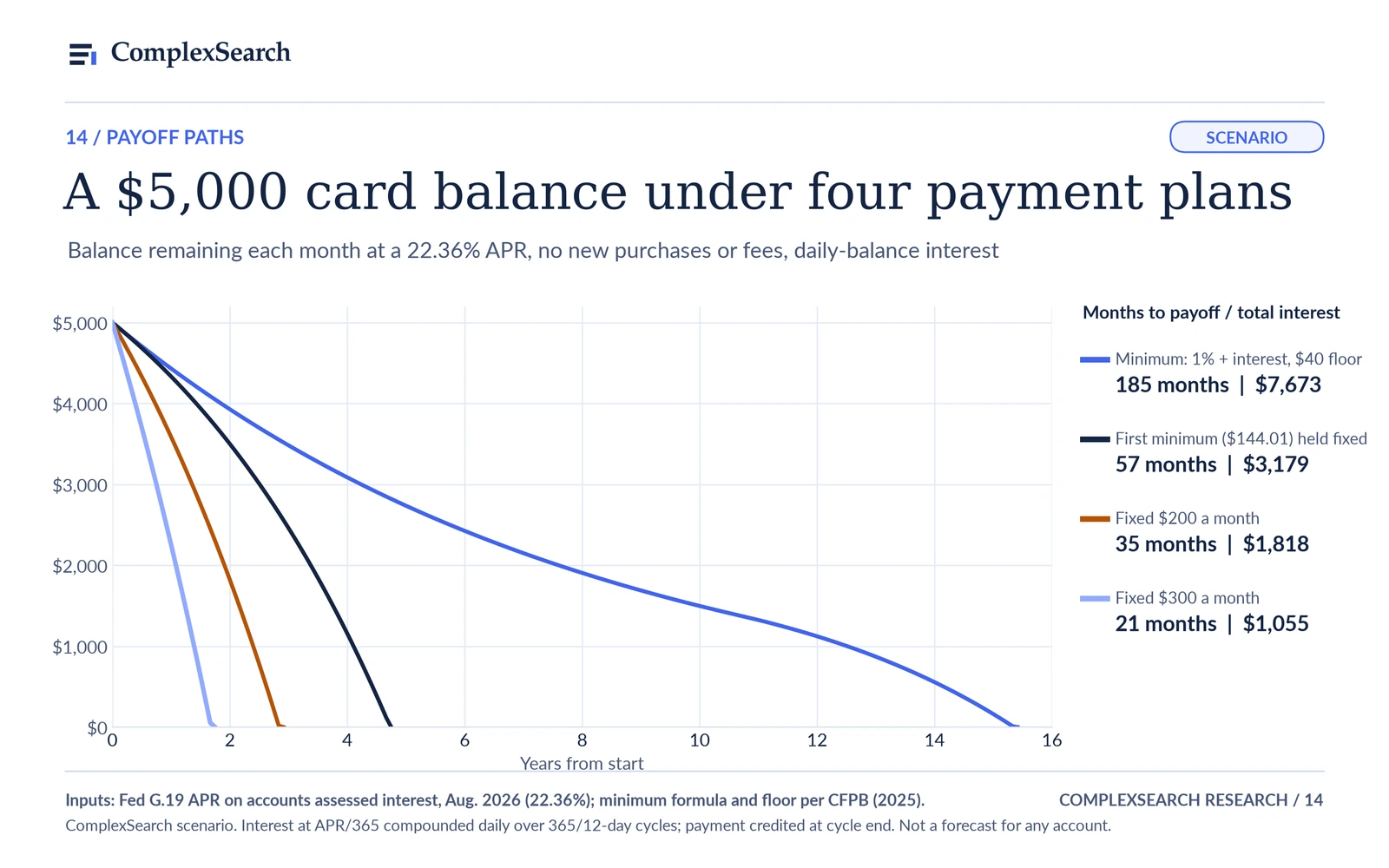
No new purchases, fees, late payments, or rate changes are modeled.
Source: ComplexSearch scheduled payment data · Direct link
| Payment rule | First payment | Months to payoff | Total interest | Interest as % of balance |
|---|---|---|---|---|
| Minimum, 1% + interest, $40 floor | $144.01 | 185 | $7,672.66 | 153% |
| Minimum, 1% + interest, $35 floor | $144.01 | 198 | $7,888.76 | 158% |
| Minimum, 1% + interest, $25 floor | $144.01 | 232 | $8,320.81 | 166% |
| 3% of statement balance, $35 floor | $152.82 | 176 | $6,811.46 | 136% |
| 2% + interest, $35 floor | $194.01 | 121 | $4,195.78 | 84% |
| 5% of statement balance, $35 floor | $254.70 | 86 | $2,701.64 | 54% |
| 4.25% + interest, $35 floor | $306.51 | 70 | $2,076.88 | 42% |
| First minimum ($144.01) held fixed | $144.01 | 57 | $3,178.71 | 64% |
| Fixed $100 a month | $100.00 | 152 | $10,113.83 | 202% |
| Fixed $200 a month | $200.00 | 35 | $1,817.80 | 36% |
| 36-month payoff payment | $192.42 | 36 | $1,926.67 | 39% |
| Fixed $300 a month | $300.00 | 21 | $1,055.28 | 21% |
| Fixed $500 a month | $500.00 | 12 | $591.38 | 12% |
Evidence: scenario. Source: the research materials. Under the APR/12 monthly method, the $40-floor minimum case takes 184 months and $7,595.94.
Sensitivity: balance and APR, minimum payment
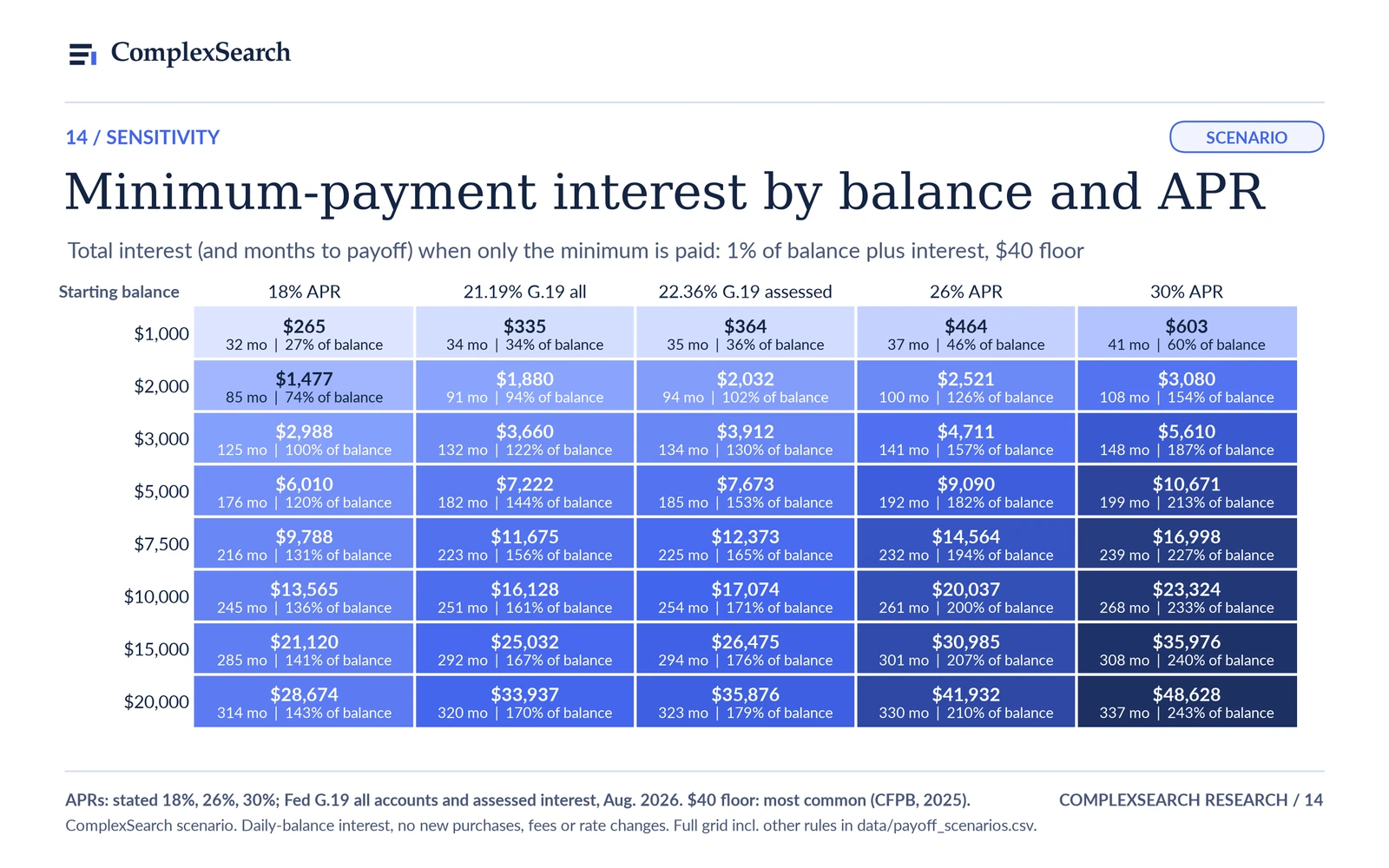
Real statement-cycle and minimum-payment rules differ by issuer.
Source: ComplexSearch sensitivity data in the research package · Direct link
Minimum payment of 1% of balance plus interest, $40 floor, daily-balance method. Each cell gives total interest, then months to payoff.
| Starting balance | 18% | 21.19% (G.19 all) | 22.36% (G.19 assessed) | 26% | 30% |
|---|---|---|---|---|---|
| $1,000 | $265 / 32 | $335 / 34 | $364 / 35 | $464 / 37 | $603 / 41 |
| $2,000 | $1,477 / 85 | $1,880 / 91 | $2,032 / 94 | $2,521 / 100 | $3,080 / 108 |
| $3,000 | $2,988 / 125 | $3,660 / 132 | $3,912 / 134 | $4,711 / 141 | $5,610 / 148 |
| $5,000 | $6,010 / 176 | $7,222 / 182 | $7,673 / 185 | $9,090 / 192 | $10,671 / 199 |
| $7,500 | $9,788 / 216 | $11,675 / 223 | $12,373 / 225 | $14,564 / 232 | $16,998 / 239 |
| $10,000 | $13,565 / 245 | $16,128 / 251 | $17,074 / 254 | $20,037 / 261 | $23,324 / 268 |
| $15,000 | $21,120 / 285 | $25,032 / 292 | $26,475 / 294 | $30,985 / 301 | $35,976 / 308 |
| $20,000 | $28,674 / 314 | $33,937 / 320 | $35,876 / 323 | $41,932 / 330 | $48,628 / 337 |
Evidence: scenario. At the $5,000 base case, each 1-point change in APR moves total interest by about $385 (20.36%: $6,905; 24.36%: $8,448). The CFPB 2024 averages give $8,776 at 25.2%, $9,680 at 27.5% and $11,190 at 31.3%.
Sensitivity: floor, percentage and fixed payment
| Input changed (base: $5,000, 22.36%, 1% + interest, $40 floor) | Months | Total interest |
|---|---|---|
| Floor $15 / $25 / $35 / $40 / $50 | 282 / 232 / 198 / 185 / 163 | $8,753 / $8,321 / $7,889 / $7,673 / $7,240 |
| Percent of balance 1% / 2% / 3% / 4.25% (plus interest, $40 floor) | 185 / 114 / 86 / 67 | $7,673 / $4,124 / $2,845 / $2,058 |
| Fixed $100 / $150 / $200 / $250 / $300 / $500 | 152 / 53 / 35 / 26 / 21 / 12 | $10,114 / $2,936 / $1,818 / $1,331 / $1,055 / $591 |
Evidence: scenario. Source: the research materials. A lower floor lengthens payoff because the minimum falls to the floor once the balance is small, and the floor sets the pace of the final years. A fixed $200 payment does not repay $15,000 or $20,000 at any modeled APR, or $10,000 at 26% or 30%, because the first month's interest exceeds $200.
Methodology
the research materials reads source files saved in raw/; rerunning with --download fetches them again. G.19 rates come from the Federal Reserve's G.19 XML package and the prime rate from the H.15 Data Download Program package. The prime rate is matched to each G.19 survey month. New York Fed figures come from the 2026Q3 data workbook. CFPB figures were taken from the published report text, with page context kept in the research dataset notes. The payoff model is a deterministic month-by-month amortization, capped at 600 months, run for every combination of balance, APR, payment rule and interest method. Every formula and assumption is listed in the research materials. the research materials draws the figures from the CSVs.
Limitations
- G.19 covers commercial banks that report to the FR 2835a survey, a voluntary panel of about 50 issuers. It excludes most credit unions and nonbank issuers. The latest quarter is preliminary.
- The accounts-assessed-interest rate is an effective rate, calculated from finance charges and balances. It includes promotional and penalty pricing in the mix and is not the APR on any single account.
- G.19, the New York Fed and the CFPB use different samples and definitions. CFPB APR averages and margins (2024, large issuers) should not be compared point for point with G.19 rates (2026, banks).
- New York Fed account counts are not de-duplicated by person, so balance per open account is not balance per cardholder. The CFPB reports an average monthly balance of about $5,300 per cardholder.
- The scenario has no new purchases, fees, promotional rates, rate changes, missed payments or grace periods. Real minimum formulas vary by issuer and may include fees and past-due amounts. Results describe repayment arithmetic, not the experience of any actual cardholder.
- The model assumes no late fees, so no figure depends on the CFPB's $8 late-fee rule. Its status is given only as reported in the CFPB's Spring 2025 Semi-Annual Report (vacatur obtained April 2025); later actions were not reviewed.
- BLS data were not needed. The FRED download returned an error, so the prime rate was taken directly from the Federal Reserve's H.15 package.
Download the report
Get the complete report, including charts, methodology and linked sources.
How to cite
ComplexSearch Research. Credit Card Interest Cost Statistics. November 2026.
To include a linked citation on your site, paste this snippet into an HTML block or your editor’s source view.