
Report overview
Quotable finding: U.S. banks with $1 billion or more in assets reported $6.25 billion in consumer overdraft and NSF fee revenue for calendar 2025 (876 reporting banks), 46.5% below the $11.68 billion reported for 2019 (658 banks), according to FFIEC Call Report data compiled by ComplexSearch.
Scenario finding: Under the overdraft terms 18 large U.S. banks published for standard consumer checking on November 23, 2026, one identical month of four overdrafts costs $0 at four banks and $40 to $200 at the other 14. If every overdraft is repaid by the next business day, 13 of the 18 charge nothing (ComplexSearch scenario).
Key numbers
| Measure | Value | Scope | Evidence |
|---|---|---|---|
| Consumer overdraft/NSF revenue, 2025 | $6.25B | 876 banks with $1B+ assets, full year | Observed |
| Same, 2019 | $11.68B | 658 banks, full year | Observed |
| Same, Jan.-Sept. 2026 | $4.59B | 504 quarterly filers | Observed |
| Same, Q3 2026 | $1.65B | 503 quarterly filers | Derived |
| Change, Q3 2026 vs. Q2 2026 | +9.4% | quarterly filers | Derived |
| Overdraft/NSF share of all deposit service charges, 2025 | 19.2% (35.9% in 2019) | same reporting banks | Derived |
| JPMorgan Chase plus Wells Fargo share of Q3 2026 | 35.8% ($590M) | quarterly filers | Derived |
| Test-month cost, 18 banks | $0 to $200; median $77.50 | standard consumer checking | Scenario |
Revenue from Call Reports
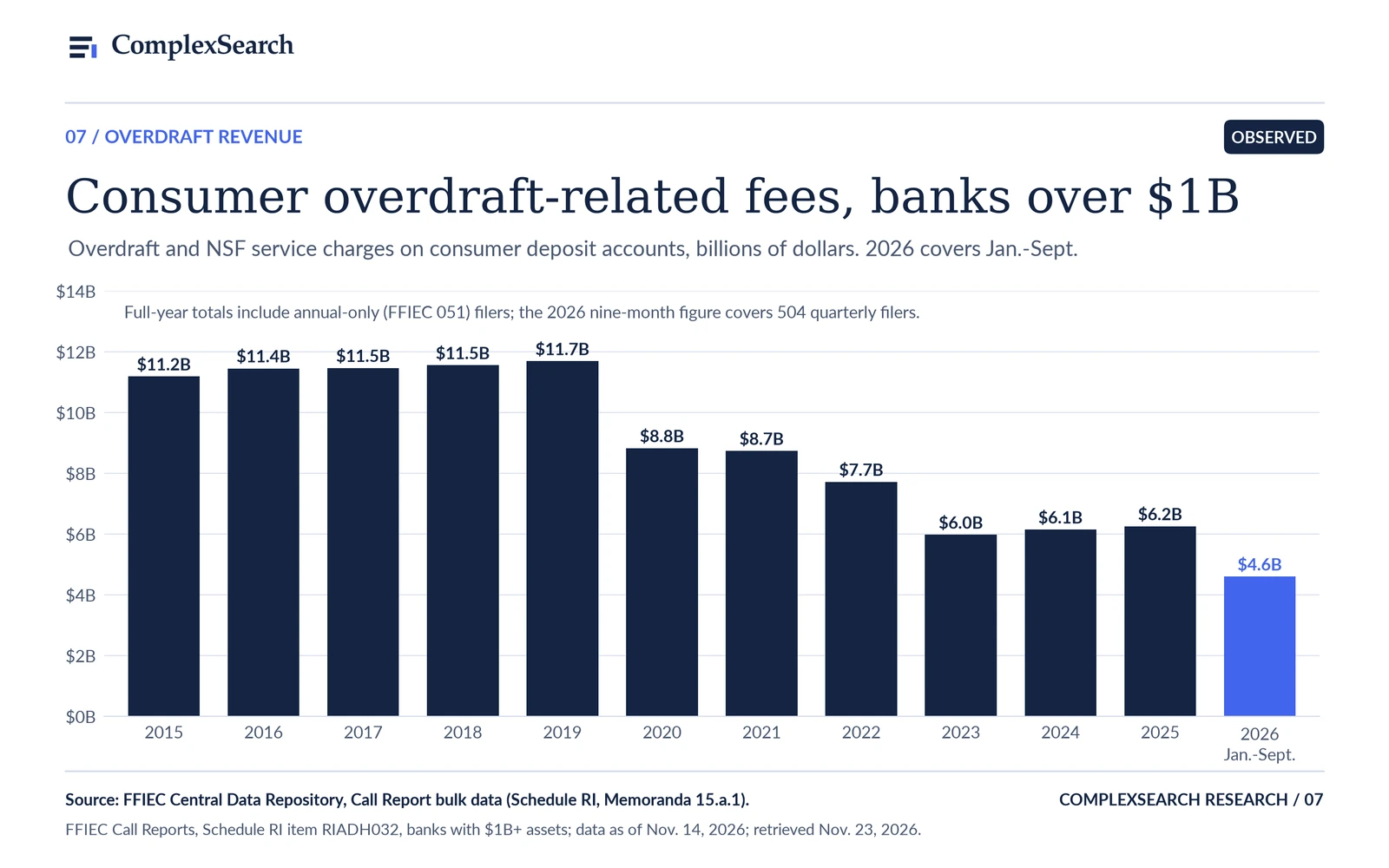
Coverage is banks with $1 billion or more in assets reporting the line item. The reporting panel changes over time.
Source: FFIEC Call Report bulk data · Direct link
Banks with $1 billion or more in total assets report consumer overdraft-related service charges, which include NSF fees, as Schedule RI Memoranda item 15.a.(1) (RIADH032) of the Call Report. We summed the as-filed values from the FFIEC Central Data Repository bulk files for every quarter from March 2015 to September 2026 (FFIEC CDR bulk download; September 2026 data as of November 14, 2026).
| Year | Banks reporting | Overdraft/NSF revenue | Share of deposit service charges |
|---|---|---|---|
| 2015 | 617 | $11.18B | 35.8% |
| 2016 | 626 | $11.45B | 35.6% |
| 2017 | 627 | $11.46B | 35.0% |
| 2018 | 638 | $11.55B | 35.5% |
| 2019 | 658 | $11.68B | 35.9% |
| 2020 | 692 | $8.82B | 29.7% |
| 2021 | 679 | $8.73B | 27.8% |
| 2022 | 828 | $7.71B | 25.2% |
| 2023 | 841 | $5.97B | 21.4% |
| 2024 | 877 | $6.14B | 20.7% |
| 2025 | 876 | $6.25B | 19.2% |
| 2026 Jan.-Sept. | 504 | $4.59B | 18.3% |
Source: ComplexSearch sums of FFIEC Call Report items RIADH032 and RIAD4080 (FFIEC CDR). The share column divides by all service charges on deposit accounts (RIAD4080) at the same banks, which includes business accounts.
Revenue has risen for two consecutive full years since the 2023 low. Quarterly, the 503 banks that file every quarter reported $1.65 billion for July-September 2026, up 9.4% from $1.51 billion in the second quarter and 6.5% from $1.55 billion in the third quarter of 2025 (519 banks). Nine-month revenue was $4.59 billion in 2026 against $4.30 billion in January-September 2025 (520 banks), a 6.8% increase.
Revenue is concentrated. JPMorgan Chase Bank ($326 million) and Wells Fargo Bank ($264 million) reported 35.8% of third-quarter 2026 revenue. The 10 largest reporters accounted for 63.8% of January-September 2026 revenue, and the 18 banks in our policy sample for 65.9%. Of the 504 quarterly filers, 65 reported zero for the nine months, including Citibank, Capital One and Ally Bank.
| Bank (charter) | 2019 | 2025 | Jan.-Sept. 2026 | Change vs. Jan.-Sept. 2025 |
|---|---|---|---|---|
| JPMorgan Chase Bank | $2,061M | $1,113M | $888M | +9.0% |
| Wells Fargo Bank | $1,696M | $928M | $721M | +4.2% |
| PNC Bank | $412M | $279M | $224M | +8.9% |
| TD Bank | $565M | $257M | $208M | +9.4% |
| U.S. Bank | $476M | $238M | $181M | +1.7% |
| Regions Bank | $373M | $219M | $176M | +10.0% |
| Bank of America | $1,563M | $152M | $168M | +50.0% |
| Truist Bank | $322M | $209M | $149M | -4.5% |
| Huntington National Bank | $146M | $126M | $119M | +27.5% |
| Citizens Bank | $214M | $124M | $98M | +8.5% |
| Fifth Third Bank | $127M | $120M | $98M | +8.9% |
| KeyBank | $149M | $67M | $50M | +0.9% |
| First-Citizens Bank & Trust | $50M | $27M | $46M | +130.0% |
| M&T (Manufacturers and Traders Trust) | $126M | $57M | $45M | +8.2% |
| Santander Bank | $66M | $31M | $26M | +13.4% |
| BMO Bank | $22M | $3M | $5M | +108.5% |
| Capital One | $154M | $0.2M | $0 | n/a |
| Citibank | $109M | $0 | $0 | n/a |
| Ally Bank | $6M | $0 | $0 | n/a |
Source: FFIEC Call Report item RIADH032 by charter as filed (FFIEC CDR). Not adjusted for mergers; several banks above acquired other banks between 2019 and 2026, so changes reflect acquisitions as well as pricing. The data do not show the reason for any change.
Revenue covers all consumer accounts at each charter, including legacy and fee-bearing products. It is not the cost of one account. Truist, for example, reported $149 million for January-September 2026 although its Truist One Checking account carries no overdraft fee.
CFPB research
The CFPB's own Call Report analysis reports $5.83 billion of overdraft/NSF revenue for 2023 and $11.96 billion for 2019, based on 617 banks merged to their December 2023 owners (CFPB data spotlight, 2024). It reported $7.7 billion for 2022 (CFPB, Q4 2022 spotlight) and estimated that banks over $1 billion account for about 77% of marketwide overdraft and NSF revenue (CFPB final rule, December 2024). Our as-filed sums differ from the CFPB's panel by 2.4% in 2019 and 2.3% in 2023 because of the bank list and merger treatment.
Regulatory status as of November 23, 2026
- The CFPB rule "Overdraft Lending: Very Large Financial Institutions" (89 FR 106768, December 30, 2024) would have applied to institutions over $10 billion from October 1, 2025. Congress disapproved it under the Congressional Review Act in S.J.Res. 18, enacted as Public Law 119-10 and approved May 9, 2025; the law states that the rule "shall have no force or effect" (Public Law 119-10; CRS Insight IN12513). The CFPB's rule page gives May 12, 2025 as the signing date (CFPB); we cite the enrolled law's date. Under the Congressional Review Act, the CFPB cannot issue a substantially similar rule without new authorization from Congress.
- The Unified Agenda lists RIN 3170-AA42 as a completed action (Reginfo.gov). We found no new CFPB overdraft rulemaking.
- The CFPB withdrew Circular 2022-06 (unanticipated overdraft fees), Circular 2024-05 (opt-in) and Bulletin 2022-06, effective May 12, 2025 (Federal Register, 90 FR 20084; CFPB withdrawn guidance).
- The FDIC rescinded its 2023 supervisory guidance on multiple re-presentment NSF fees on April 10, 2026 (FDIC FIL-14-2026).
- Regulation E's opt-in requirement for ATM and one-time debit card overdraft fees (12 CFR 1005.17) remains in effect.
Bank policies
Terms below are for each bank's standard fee-bearing consumer checking account, read from issuer pages on November 23, 2026. Full parameters and notes are in the research materials.
| Bank | Fee per item | Daily cap | No-fee threshold | Grace period |
|---|---|---|---|---|
| JPMorgan Chase | $34 | 3 ($102) | items ≤$5; overdrawn ≤$50 at day end | to ≤$50 overdrawn by next business day (Chase) |
| Bank of America | $10 ($15 from Feb. 19, 2027) | 2 | items ≤$1 or overdrawing ≤$1; no fee on one-time debit/ATM | none |
| Wells Fargo | $35 | 3 | items ≤$10; overdrawn ≤$10 at day end | $0+ by next business day |
| Citibank | $0 | n/a | n/a | n/a |
| U.S. Bank | $36 | 3 | items ≤$5; overdrawn ≤$50 at day end | to ≤$50 overdrawn on fee day (U.S. Bank) |
| PNC Virtual Wallet | $36 | 1 | overdrawn ≤$5 at day end | Extra Time to $0+ |
| Truist One | $0 (other accounts $36) | n/a | n/a | n/a |
| Capital One 360 | $0 | n/a | n/a | n/a |
| TD Bank | $35 | 3 | overdrawn ≤$50 | $0+ by 11 PM ET next business day |
| Fifth Third Momentum | $35 | 3 | items ≤$5; overdrawn ≤$5 at day end | Extra Time to midnight ET next business day |
| Citizens | $35 | 5 ($175) | items ≤$5 or overdrawn ≤$5 | positive by 10 PM ET next business day |
| KeyBank | $20 (+$20 after 5 days overdrawn) | 3 ($60) | overdrawn ≤$20 at day end | none |
| Huntington | $15 | 3 | overdrawn ≤$50 | positive by midnight CT next business day |
| M&T | $15 per day | 1 | items <$5 | none |
| Ally Bank | $0 | n/a | n/a | n/a |
| First Citizens | $25 | 3 | items ≤$5 | none stated |
| BMO | $20 | 3 | items ≤$5; overdrawn ≤$20 at day end | to ≤$20 overdrawn at next day's close |
| Santander | $15 (+$15 after 5 days) | 3 | fee only when an item leaves balance overdrawn >$100 | none |
Regions Bank is not included. The only Regions fee schedule we could retrieve was effective August 5, 2020.
ComplexSearch scenario
Test month
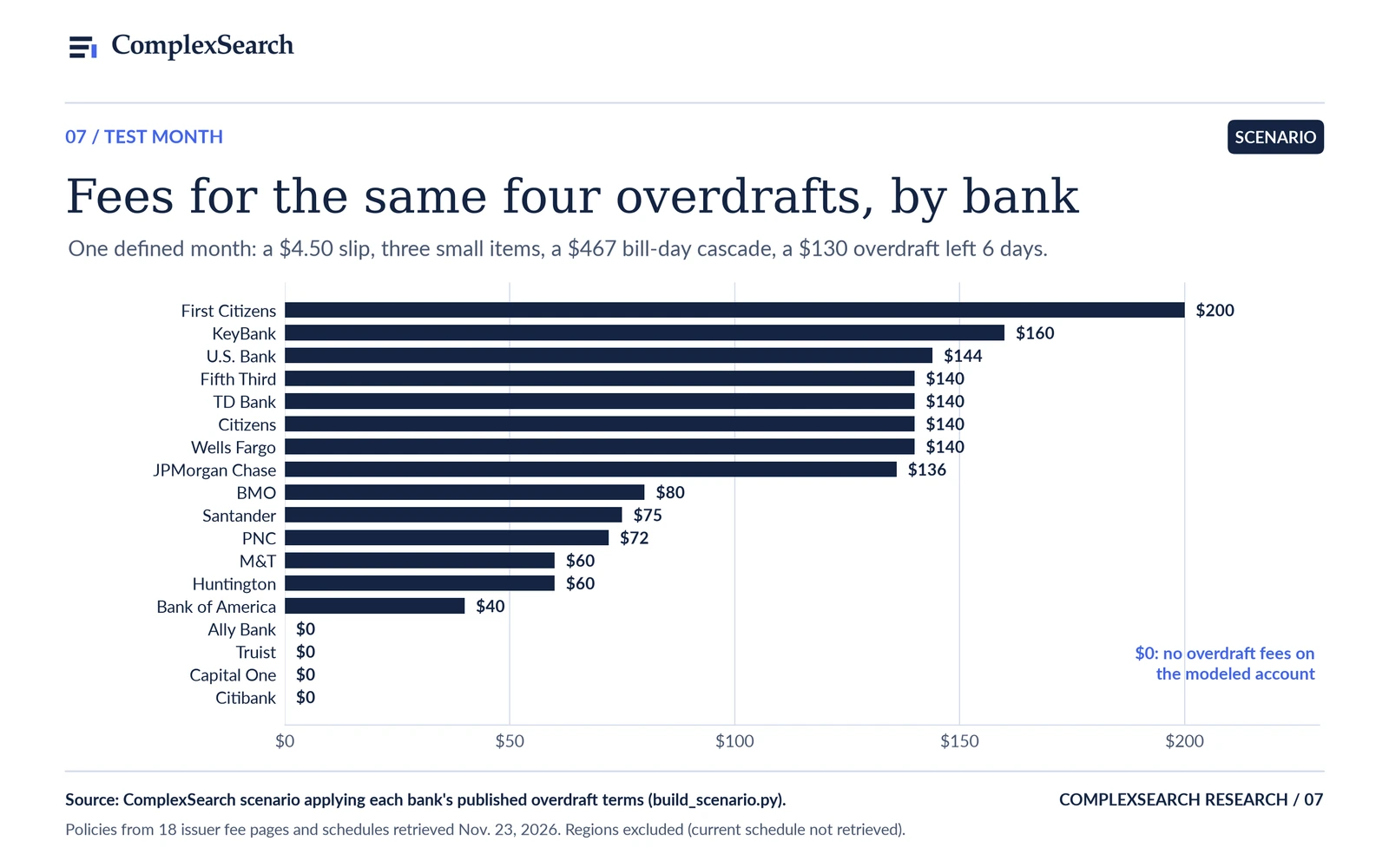
The model applies the sampled accounts’ policies to one defined transaction sequence, not typical customer behavior.
Source: Bank disclosures in the underlying policy dataset · Direct link
We priced one defined month of overdrafts under each bank's published rules. The same items post in the same order at every bank, the customer has opted in to debit card overdraft coverage, and every item is paid.
| Episode | Setup | Repaid |
|---|---|---|
| E1 small debit slip | $20 balance; $24.50 debit card purchase; overdrawn $4.50 | next business day |
| E2 three small items | $30 balance; $45 and $6 debit card purchases, $15.99 recurring subscription; overdrawn $36.99 | next business day |
| E3 bill-day cascade | $60 balance; $385 ACH bill, $120 check, $18 and $4 debit card purchases; overdrawn $467 | after 3 business days |
| E4 lingering ACH | $10 balance; $140 ACH utility debit; overdrawn $130 | after 6 business days |
Scenario results (ComplexSearch scenario, the research materials):
| Bank | E1 | E2 | E3 | E4 | Month | All repaid next day | Small ones repaid day 2 | No debit opt-in |
|---|---|---|---|---|---|---|---|---|
| First Citizens | $25 | $75 | $75 | $25 | $200 | $200 | $200 | $75 |
| KeyBank | $0 | $60 | $60 | $40 | $160 | $140 | $160 | $80 |
| U.S. Bank | $0 | $0 | $108 | $36 | $144 | $0 | $144 | $108 |
| Citizens | $0 | $0 | $105 | $35 | $140 | $0 | $245 | $105 |
| Fifth Third | $0 | $0 | $105 | $35 | $140 | $0 | $245 | $105 |
| TD Bank | $0 | $0 | $105 | $35 | $140 | $0 | $140 | $105 |
| Wells Fargo | $0 | $0 | $105 | $35 | $140 | $0 | $210 | $105 |
| JPMorgan Chase | $0 | $0 | $102 | $34 | $136 | $0 | $136 | $102 |
| BMO | $0 | $0 | $60 | $20 | $80 | $0 | $140 | $60 |
| Santander | $0 | $0 | $45 | $30 | $75 | $60 | $75 | $60 |
| PNC | $0 | $0 | $36 | $36 | $72 | $0 | $108 | $72 |
| Huntington | $0 | $0 | $45 | $15 | $60 | $0 | $60 | $45 |
| M&T | $15 | $15 | $15 | $15 | $60 | $60 | $60 | $30 |
| Bank of America | $0 | $10 | $20 | $10 | $40 | $40 | $40 | $30 |
| Ally, Capital One 360, Citibank, Truist One | $0 | $0 | $0 | $0 | $0 | $0 | $0 | $0 |
What changes the cost in this scenario:
- End-of-day cushions decide the small episodes. The $4.50 slip (E1) is charged only at First Citizens and M&T, which have no balance cushion. The $36.99 overdraft from three small items (E2) is charged at four banks (Bank of America, First Citizens, KeyBank, M&T); the others waive it through a $50 cushion (Chase, U.S. Bank, TD, Huntington) or next-day grace.
- Grace periods matter only when the customer repays within one business day. Nine of the 14 fee-charging banks charge $0 for the month if every overdraft is repaid by the next business day. Moving the two small repayments from day 1 to day 2 raises the month to $245 at Citizens and Fifth Third and $210 at Wells Fargo.
- Daily caps set the price of the cascade (E3). PNC's one-fee-per-day limit holds it to $36; Bank of America's two-fee limit holds it to $20; three-fee caps put it at $102 to $108 at Chase, U.S. Bank and the $35 banks.
- Sustained-overdraft fees add $20 at KeyBank and $15 at Santander for E4, which stays overdrawn six business days.
- Without debit card opt-in, the one-time debit items are declined. The month costs $30 to $108 at the 14 fee-charging banks.
- Bank of America's announced $15 fee from February 19, 2027 raises its test month from $40 to $60.
Sensitivity
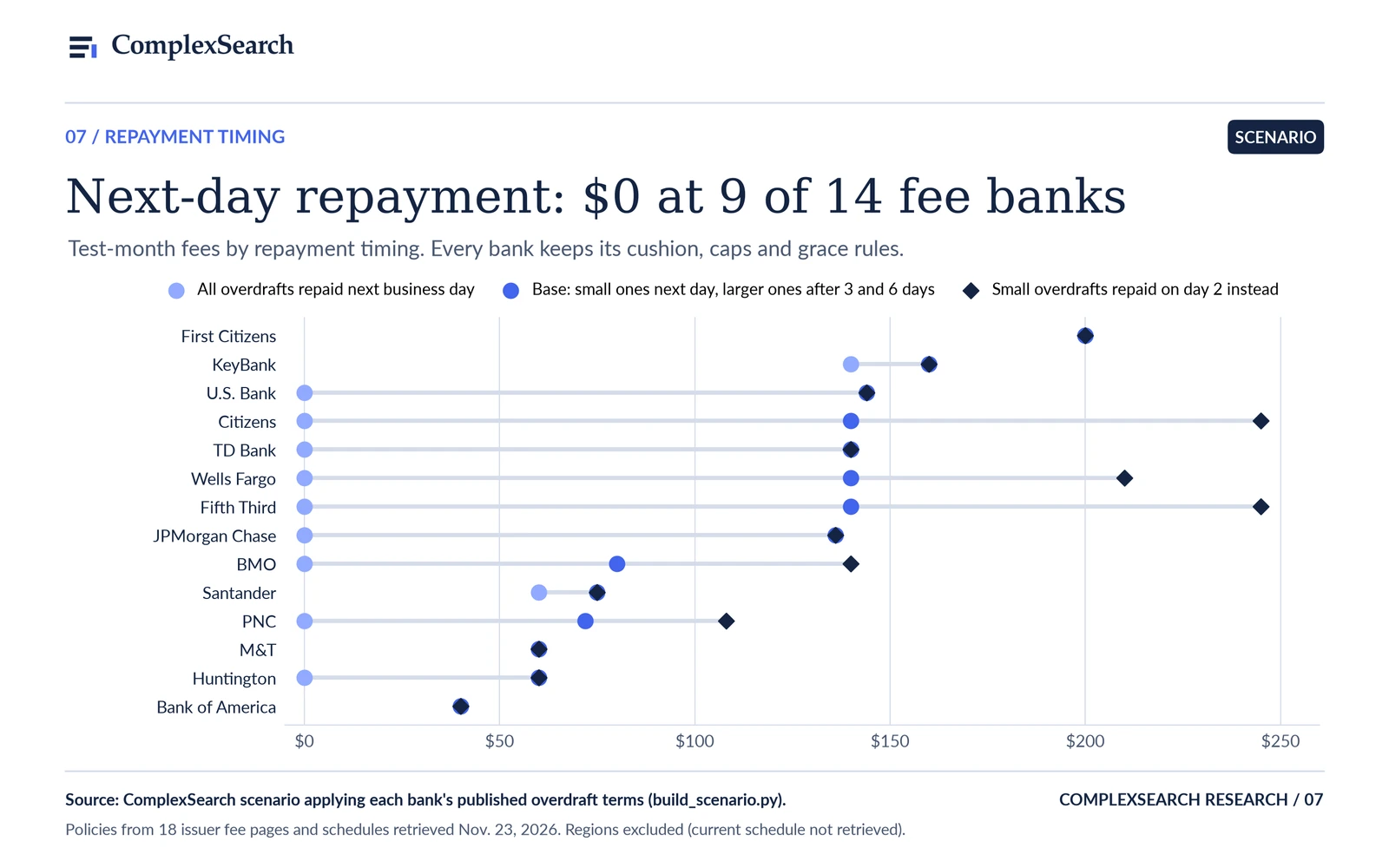
Modeled amounts depend on the size and timing of the same transaction sequence and each bank’s published grace rules.
Source: Bank disclosures in the underlying policy dataset · Direct link
Single overdraft of $130 (one $150 ACH from a $20 balance), by business days until repayment (ComplexSearch scenario, the research materials):
| Bank | 1 day | 2 days | 3-4 days | 5-6 days |
|---|---|---|---|---|
| Chase, Wells Fargo, U.S. Bank, PNC, TD, Fifth Third, Citizens | $0 | $34-$36 | $34-$36 | $34-$36 |
| Huntington | $0 | $15 | $15 | $15 |
| BMO | $0 | $20 | $20 | $20 |
| KeyBank | $20 | $20 | $20 | $40 |
| Santander | $15 | $15 | $15 | $30 |
| First Citizens | $25 | $25 | $25 | $25 |
| M&T | $15 | $15 | $15 | $15 |
| Bank of America | $10 | $10 | $10 | $10 |
Single ACH item from a $0 balance, repaid after 3 business days, by amount (and overdrawn balance):
| Bank | $3 | $8 | $15 | $25 | $45 | $60 | $110+ |
|---|---|---|---|---|---|---|---|
| PNC, Citizens, Fifth Third | $0 | $35-$36 | $35-$36 | $35-$36 | $35-$36 | $35-$36 | $35-$36 |
| Wells Fargo | $0 | $0 | $35 | $35 | $35 | $35 | $35 |
| BMO, KeyBank | $0 | $0 | $0 | $20 | $20 | $20 | $20 |
| Chase, U.S. Bank, TD | $0 | $0 | $0 | $0 | $0 | $34-$36 | $34-$36 |
| Huntington | $0 | $0 | $0 | $0 | $0 | $15 | $15 |
| Santander | $0 | $0 | $0 | $0 | $0 | $0 | $15 |
| First Citizens | $0 | $25 | $25 | $25 | $25 | $25 | $25 |
| M&T | $0 | $15 | $15 | $15 | $15 | $15 | $15 |
| Bank of America | $10 | $10 | $10 | $10 | $10 | $10 | $10 |
Several $80 checks on one day from a $0 balance, repaid after 3 business days: one check costs $0 at Santander (below its $100 threshold) and $10-$36 elsewhere; three checks cost $102-$108 at Chase, U.S. Bank, TD, Wells Fargo, Fifth Third and Citizens; six checks cost $175 at Citizens (five-fee cap), stay at $102-$108 at the other $34-$36 banks, and stay at $36 at PNC and $15 at M&T. Bank of America's $3 row is $10 because its exemption covers only items of $1 or less.
Changing every per-item fee by plus or minus 30% moves each bank's test-month total proportionally, for example $95 to $177 at Chase and $140 to $260 at First Citizens; sustained fees are held constant (full grid in the research materials).
Methodology
Observed revenue figures are sums of as-filed Call Report values from 47 quarterly FFIEC bulk files (March 2015 to September 2026). Full-year totals use December year-to-date values. Quarterly figures are derived from year-to-date differences for banks that filed the item in consecutive quarters. Policy terms were read from each bank's public overdraft page or fee schedule on November 23, 2026 and saved in raw/fee_pages/. The scenario applies those terms with a simple engine (the research materials); every rule and simplification is listed in the research materials.
Limitations
- Measurement change: FFIEC 051 filers with $1 billion or more in assets report the overdraft item only in December. Full-year totals include them; quarterly and nine-month figures do not. The number of reporting banks rose from 658 in 2019 to 876 in 2025, so totals are not a fixed panel.
- Charter-level figures are not adjusted for mergers, and the revenue item mixes overdraft and NSF fees on all consumer accounts.
- Banks under $1 billion and credit unions are not covered.
- The scenario uses one posting order, treats available balance as ledger balance, and ignores pending items, holds, overdraft protection transfers and bank discretion to decline items. Real fees depend on the account agreement and processing order.
- Some fee-page footnotes (Wells Fargo modal footnotes, Huntington) could not be captured in full. Truist's schedule document is dated December 7, 2026. Regions is excluded.
Download the report
Get the complete report, including charts, methodology and linked sources.
How to cite
ComplexSearch Research. Overdraft Fees & Statistics, 2026. November 2026.
To include a linked citation on your site, paste this snippet into an HTML block or your editor’s source view.