
Report overview
On November 23, 2026, the median standard APY across a sample of 24 online savings accounts and one online money-market savings account checked by ComplexSearch on issuer websites was 3.75%, about 9.6 times the FDIC national savings rate of 0.39% (November 16, 2026 release).
The sample is a selection of widely available online accounts that ComplexSearch checked directly on issuer websites. It is not a market-wide average. The FDIC national rate is a deposit-weighted average across banks and credit unions.
FDIC national savings and money market rates
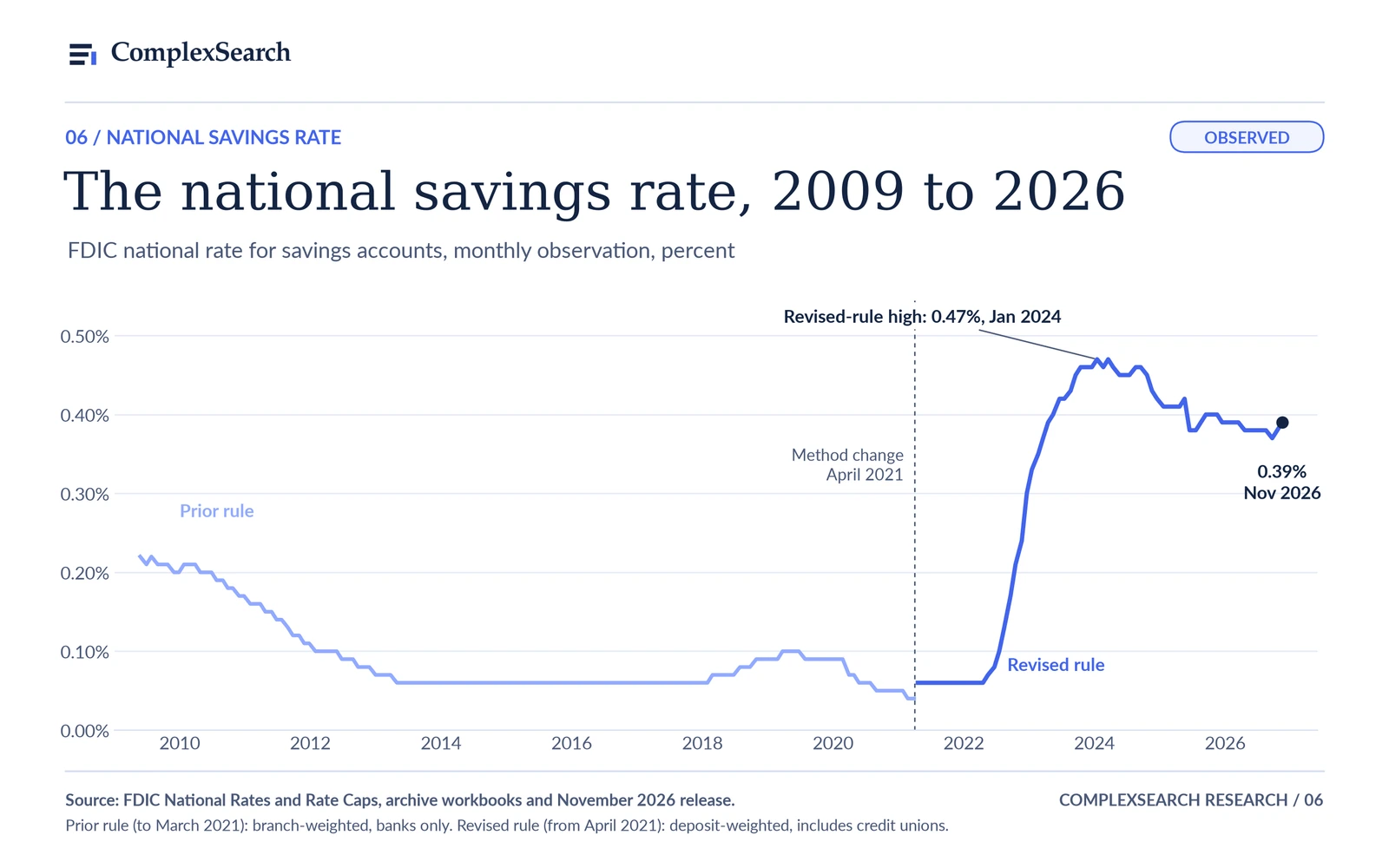
The FDIC changed its benchmark method in April 2021; the two periods are shown separately.
Source: FDIC historical rate archive · Direct link
The FDIC National Rates and Rate Caps release for November 2026, dated November 16, 2026, puts the national savings rate at 0.39%. It puts the money market rate at 0.64% and interest checking at 0.07%. The savings national rate cap is 4.63%. The FDIC measures savings at the $2,500 product tier and money market as the average of the $10,000 and $100,000 tiers. Published rates reflect data from the last business day of the prior month.
| Month (FDIC release) | Savings national rate | Money market national rate |
|---|---|---|
| November 2026 | 0.39% | 0.64% |
| October 2026 | 0.38% | 0.63% |
| September 2026 | 0.37% | 0.63% |
| December 2025 | 0.39% | 0.58% |
| November 2025 | 0.40% | 0.58% |
| December 2024 | 0.42% | 0.66% |
| January 2024 (savings series high) | 0.47% | 0.65% |
| December 2023 | 0.46% | 0.64% |
| December 2022 | 0.30% | 0.38% |
| April 2021 (revised method begins) | 0.06% | 0.06% |
Source: FDIC national rate archive workbooks, revised rule, April 2021 onward and prior rule, 2009 to March 2021. The full monthly series is in the research materials.
Under the current method, the savings rate rose from 0.06% in April 2021 to a high of 0.47% in January 2024, a level it matched in March 2024. It then eased to 0.42% by December 2024. Over the 14 months through November 2026 it stayed between 0.37% and 0.40%. Under the prior method, which used branch weighting and excluded credit unions, the series hit a low of 0.04% in March 2021. The two methods are not directly comparable. Charts show them as separate lines.
Issuer-verified high-yield savings sample
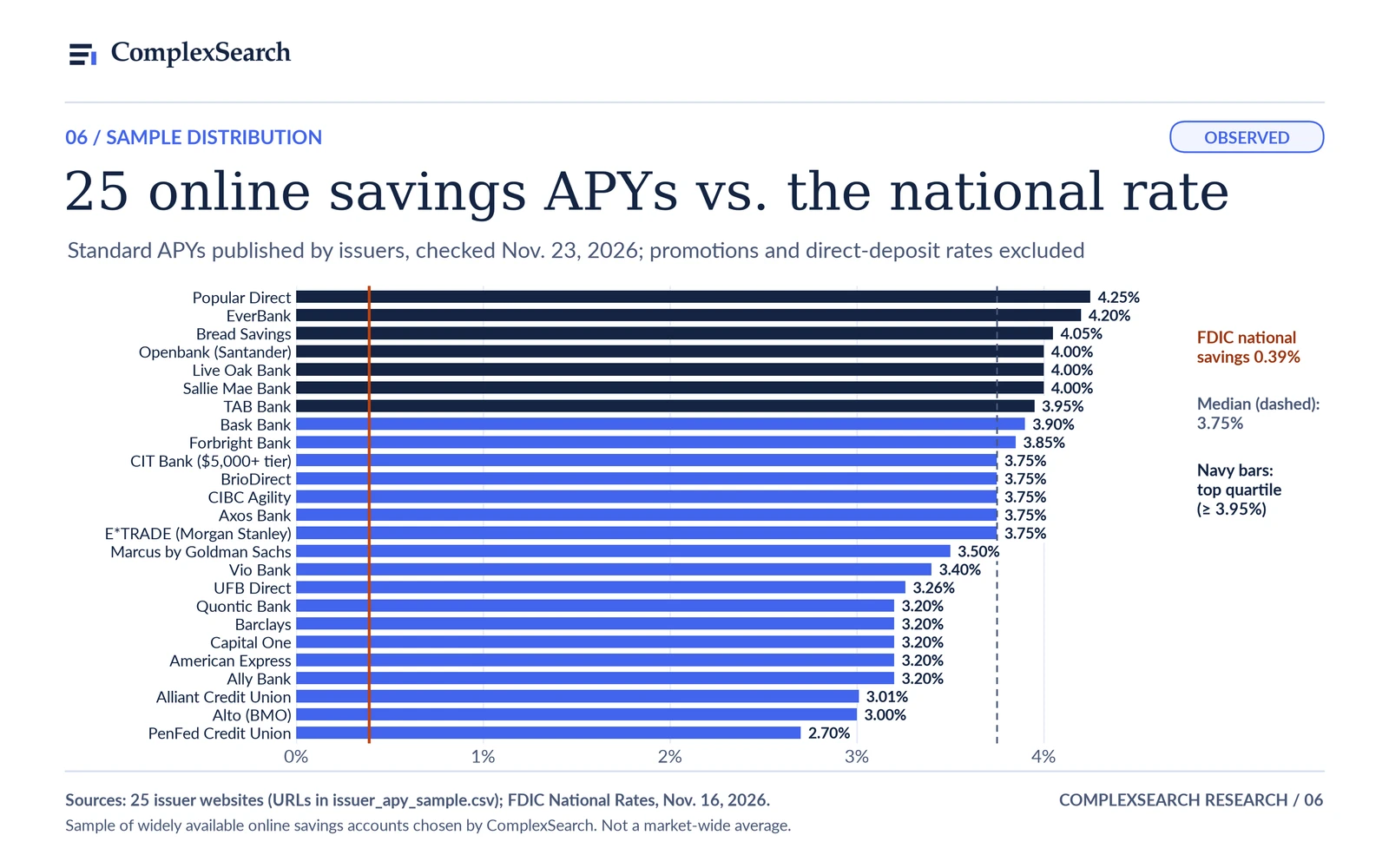
The sample includes 24 savings accounts and one money-market savings account. It is not a market-wide average.
Source: Issuer disclosures in the underlying sample; FDIC benchmark · Direct link
ComplexSearch read standard APYs from 31 issuer account pages on November 23, 2026. The core sample has 25 accounts that pay their headline rate without recurring deposit or direct-deposit conditions. Promotional and boosted rates are excluded, and the standard rate is used in their place.
| Statistic (core sample, n = 25) | APY | Versus FDIC national savings (0.39%) |
|---|---|---|
| Highest | 4.25% | +386 bp |
| Top quartile (Q3) | 3.95% | 10.1×, +356 bp |
| Median | 3.75% | 9.6×, +336 bp |
| Mean | 3.59% | 9.2×, +320 bp |
| Bottom quartile (Q1) | 3.20% | 8.2×, +281 bp |
| Lowest | 2.70% | 6.9×, +231 bp |
The lowest APY in the sample is still 2.31 percentage points above the national savings rate. Fourteen of the 25 accounts pay 3.75% or more, and five pay 3.20%.
| Institution and account | Standard APY | Minimum to open or earn | Issuer as-of date |
|---|---|---|---|
| Popular Direct Plus Savings | 4.25% | $5,000 | Nov 23, 2026 |
| EverBank Performance Savings | 4.20% | $0 | Nov 20, 2026 |
| Bread Savings High-Yield Savings | 4.05% | $100 | Nov 23, 2026 |
| Openbank High Yield Savings | 4.00% | $500 | "Today" (Nov 23, 2026) |
| Live Oak Bank Personal Savings | 4.00% | $0 | Nov 16, 2026 |
| Sallie Mae High-Yield Savings | 4.00% | $0 | Nov 23, 2026 |
| TAB Bank TAB Save | 3.95% | $0 | Nov 23, 2026 |
| Bask Bank Savings | 3.90% | $0 | "Today" (Nov 23, 2026) |
| Forbright Growth Savings | 3.85% | Not stated | Nov 23, 2026 |
| CIT Bank Platinum Savings | 3.75% on $5,000+ (0.25% below $5,000) | $100 | Jul 1, 2026 |
| Axos Bank Summit Savings | 3.75% | $0 | Nov 23, 2026 |
| BrioDirect High-Yield Savings | 3.75% | $5,000 | Nov 23, 2026 |
| CIBC Agility Savings | 3.75% | $1,000 | Sep 22, 2026 |
| E*TRADE Premium Savings | 3.75% | $0 | Nov 23, 2026 |
| Marcus Online Savings | 3.50% | $0 | Nov 23, 2026 |
| Vio Bank Cornerstone Money Market Savings | 3.40% | $100 | Nov 17, 2026 |
| UFB Portfolio Savings | 3.26% | $0 | Nov 23, 2026 |
| Ally Online Savings | 3.20% | $0 | Nov 19, 2026 |
| American Express High Yield Savings | 3.20% | $0 | Nov 23, 2026 |
| Barclays Online Savings | 3.20% | $0 | Oct 7, 2026 |
| Capital One 360 Performance Savings | 3.20% | $0 | Nov 23, 2026 |
| Quontic High Yield Savings | 3.20% | $100 | Not shown |
| Alliant Credit Union High-Rate Savings | 3.01% | $100 average balance | Oct 8, 2026 |
| Alto (BMO) High Yield Online Savings | 3.00% | $0 | Nov 23, 2026 |
| PenFed Premium Online Savings | 2.70% | $5 | Nov 1, 2026 |
All rates are variable and were displayed on the issuer page on November 23, 2026. Every row in the research materials includes the full URL, check date, tier wording, notes and the saved page capture.
Four accounts advertise a higher rate only when the holder meets ongoing conditions. They are recorded but kept out of the statistics:
- LendingClub LevelUp Savings pays 4.20% with $250 in monthly deposits and 3.00% otherwise.
- SoFi Savings pays 3.30% with direct deposit.
- Upgrade Performance Savings pays 3.30% with $1,000 or more in monthly direct deposits and 1.50% otherwise.
- Varo Savings pays 3.75% on the first $5,000 when qualifying conditions are met and 1.00% otherwise.
ComplexSearch scenario: one-year earnings gap by balance
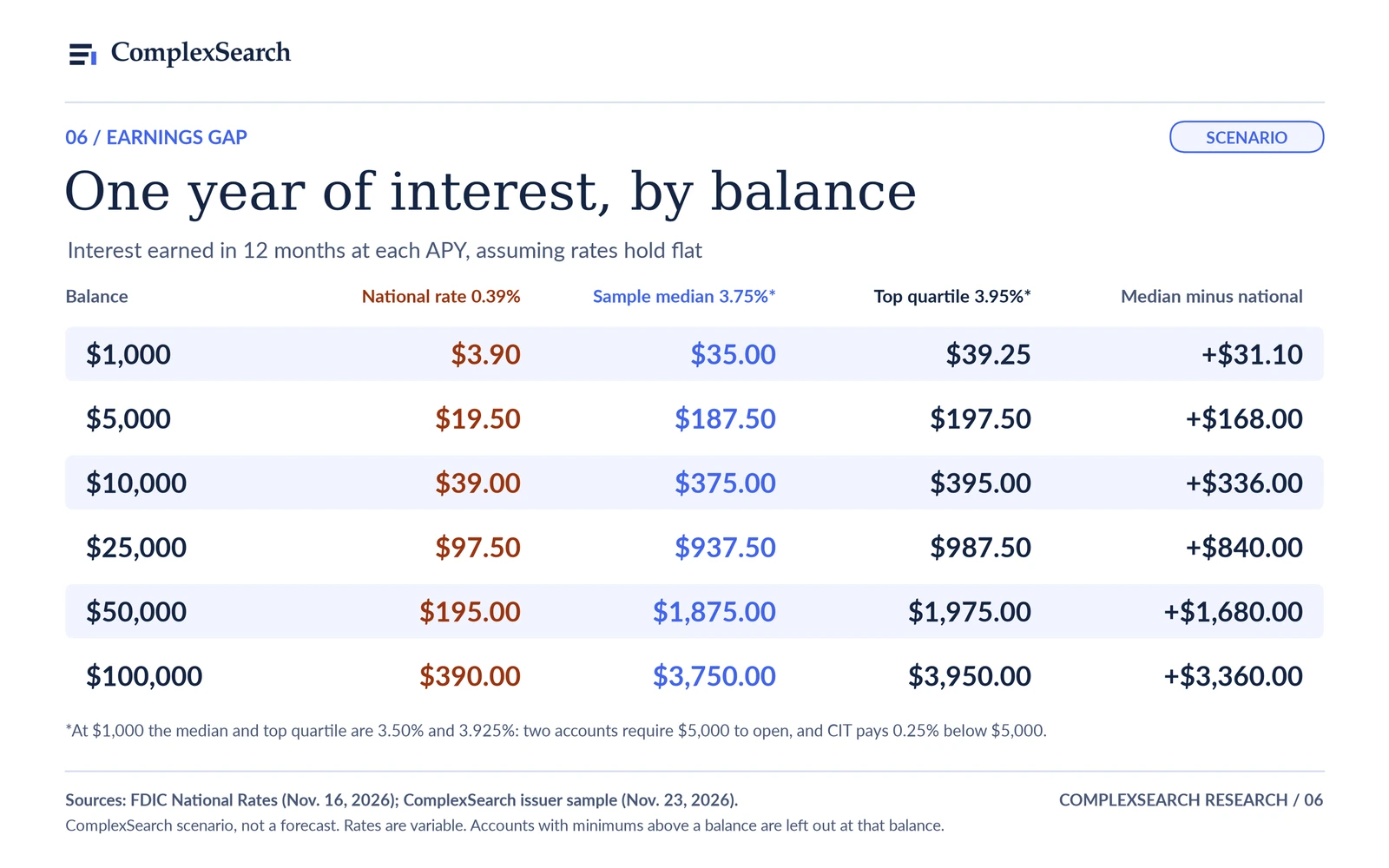
This illustration holds rates flat, excludes taxes and fees, and does not predict future returns.
Source: FDIC benchmark and ComplexSearch issuer sample · Direct link
This is a ComplexSearch scenario, not observed data or a forecast. It shows interest earned in 12 months at each APY, assuming rates hold flat. APY already reflects compounding, so one-year interest is balance × APY. There are no deposits, withdrawals, fees or taxes. At each balance, only accounts the balance can open count toward the median and top quartile, and each account is counted at the rate it pays at that balance. At $1,000, the two $5,000-minimum accounts drop out and CIT counts at its 0.25% sub-$5,000 rate, leaving 23 accounts: median 3.50%, Q3 3.925%.
| Balance | Interest at FDIC national rate (0.39%) | Interest at sample median | Interest at sample top quartile | Gap, median vs national |
|---|---|---|---|---|
| $1,000 | $3.90 | $35.00 (3.50%) | $39.25 (3.925%) | +$31.10 |
| $5,000 | $19.50 | $187.50 (3.75%) | $197.50 (3.95%) | +$168.00 |
| $10,000 | $39.00 | $375.00 | $395.00 | +$336.00 |
| $25,000 | $97.50 | $937.50 | $987.50 | +$840.00 |
| $50,000 | $195.00 | $1,875.00 | $1,975.00 | +$1,680.00 |
| $100,000 | $390.00 | $3,750.00 | $3,950.00 | +$3,360.00 |
In this scenario, $10,000 earns $39 in a year at the national savings rate and $375 at the sample median, a difference of $336. Formulas are in the research materials.
Sensitivity: gap by comparison APY
ComplexSearch scenario. This table shows one-year interest at each comparison APY minus interest at the FDIC national savings rate of 0.39%, under the same assumptions. The 3.00% to 4.25% range covers most of the core sample.
| Balance | 3.00% | 3.50% | 3.75% | 4.00% | 4.25% |
|---|---|---|---|---|---|
| $1,000 | +$26.10 | +$31.10 | +$33.60 | +$36.10 | +$38.60 |
| $5,000 | +$130.50 | +$155.50 | +$168.00 | +$180.50 | +$193.00 |
| $10,000 | +$261.00 | +$311.00 | +$336.00 | +$361.00 | +$386.00 |
| $25,000 | +$652.50 | +$777.50 | +$840.00 | +$902.50 | +$965.00 |
| $50,000 | +$1,305.00 | +$1,555.00 | +$1,680.00 | +$1,805.00 | +$1,930.00 |
| $100,000 | +$2,610.00 | +$3,110.00 | +$3,360.00 | +$3,610.00 | +$3,860.00 |
Each 0.25 percentage point of APY changes the one-year gap by $25 per $10,000. Values are in the research materials.
Methodology
- National rate. The FDIC savings national rate, from the November 2026 release and both archive workbooks. One value is kept per month: for weekly prior-rule data, the latest week starting in the month; for revised-rule data, the latest release in the month. This matches the monthly selection in ComplexSearch Research #2 (CD rates).
- Sample. ComplexSearch chose widely available online savings and money market savings accounts that can be opened nationally online, from banks and two open-membership credit unions. Each standard APY was read on the issuer's own website on November 23, 2026. No aggregator or third-party rate was used. Two rates found in earlier ComplexSearch rate-evidence files (EverBank and PenFed) were re-checked on the issuer sites today. The CIT and Axos pages were read with a headless Chromium browser because a plain fetch returned no rates or only promotional rates.
- Statistics. Quartiles use linear interpolation, the same as Excel PERCENTILE.INC.
- Reproduce. Run
python3 the research materials, thenpython3 the research materials.
Limitations
- The sample is not random or weighted, and it does not represent all savings accounts. A different set of accounts would produce a different median.
- The FDIC national rate is a deposit-weighted average at the $2,500 tier. It is a different measure from a list of online-account APYs. Their ratio describes this sample against that benchmark only.
- Issuer pages change without notice. Nine core rates carry issuer dates earlier than the check date, from July 1 (CIT) to November 20, 2026, and Quontic's page shows no date. All were still displayed on the check date.
- Two issuers could not be confirmed and are excluded. Both returned "Access Denied" to a headless browser on two attempts on November 23, 2026:
- Synchrony: an earlier plain fetch showed conflicting values, 3.75% under "Special Member Rates" and 2.85% in the calculator.
- Citizens Access: an earlier plain fetch of the rate sheet returned unfilled placeholders.
- CIT Platinum Savings is tiered. It counts at 3.75% in the sample statistics, which is its rate at $5,000 and above. In the $1,000 scenario it counts at 0.25%.
- Axos Summit Savings and UFB Portfolio Savings are separate products from the same bank (Axos Bank) and are counted separately.
- Discover's savings page now leads to Capital One 360 Performance Savings, which is counted once.
- The FDIC method changed in April 2021, so the prior- and revised-rule series are not compared directly.
- The scenario leaves out rate changes, taxes, inflation and deposit-insurance limits.
Download the report
Get the complete report, including charts, methodology and linked sources.
How to cite
ComplexSearch Research. Average Savings Rates and the High-Yield Gap. November 2026.
To include a linked citation on your site, paste this snippet into an HTML block or your editor’s source view.