
Report overview
Across the published APR ranges of 19 personal lenders checked on their own websites on November 23, 2026, the median published minimum was 7.99% and the median published maximum 25.74%. Applied to $10,000 over 60 months, those two endpoints illustrate total payments of $12,163 and $17,872, a $5,709 spread (ComplexSearch scenario).
The dollar figures illustrate the sample's published APR endpoints. They are not loan offers or quotes for a $10,000, 60-month loan: several lenders attach their published minimum to other amounts, terms, discounts or credit profiles, so an endpoint may not be available at that amount and term (see the condition check below). The median minimum and maximum are not what typical borrowers pay. The sample covers 11 banks, 2 credit unions and 6 online lenders. It is not a market-wide average.
National averages
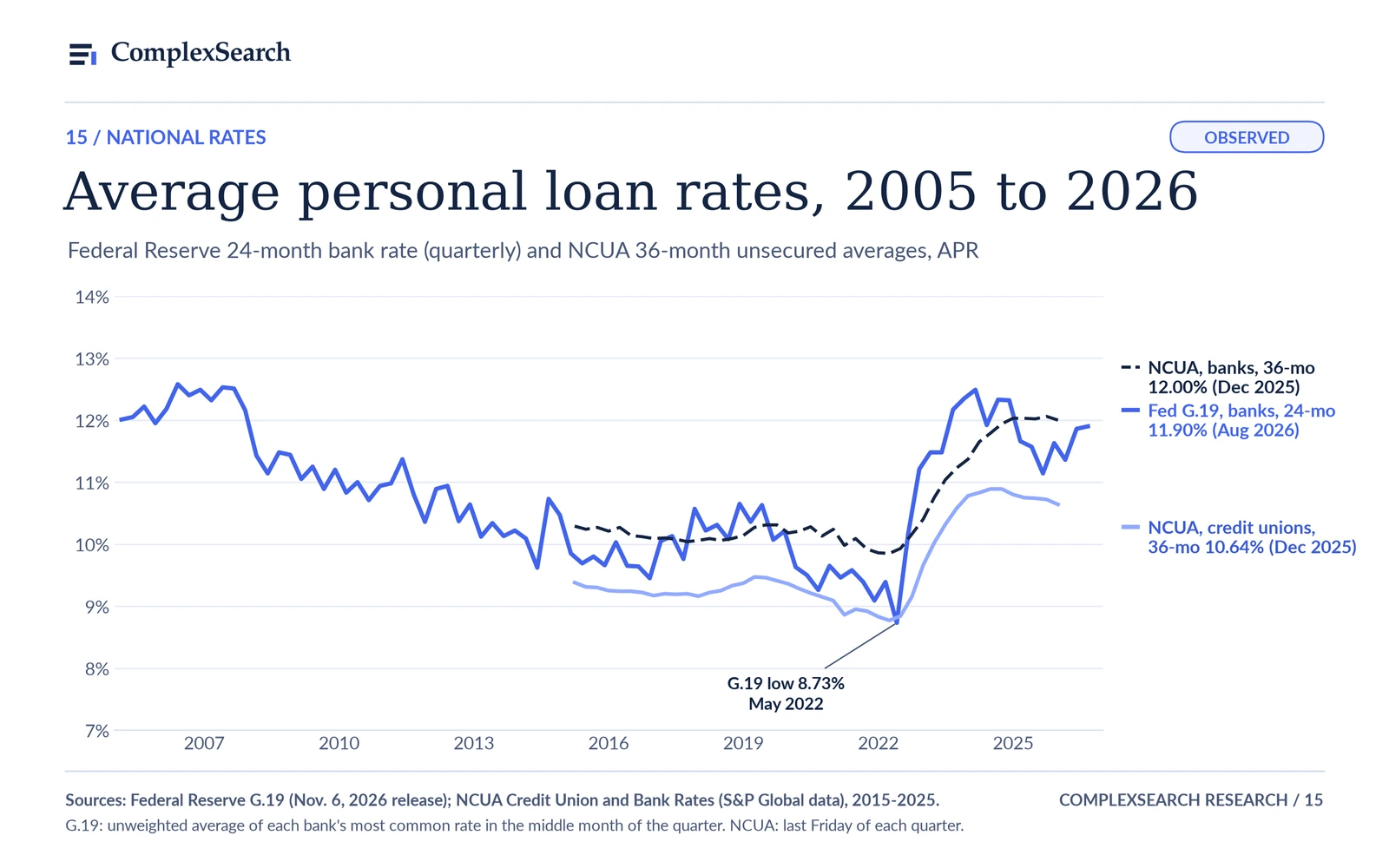
The NCUA series in this edition ends in 2025 Q4; compare each series within its own coverage.
Source: Federal Reserve G.19 and NCUA benchmarks · Direct link
The Federal Reserve's G.19 Consumer Credit release of November 6, 2026 puts the average rate on 24-month personal loans at commercial banks at 11.90% for the August 2026 survey. That is up from 11.14% in August 2025 and from a low of 8.73% in May 2022. The February 2024 reading of 12.49% was the highest since August 2007. The series is a simple unweighted average of each reporting bank's most common rate, collected once a quarter. The full quarterly history from 1972 is in the research materials, built from the G.19 data package.
The NCUA's Credit Union and Bank Rates tables, which republish S&P Global Market Intelligence data, show a different product: a 36-month unsecured fixed-rate loan.
| Quarter (NCUA) | Credit union average | Bank average |
|---|---|---|
| December 2025 | 10.64% | 12.00% |
| December 2024 | 10.80% | 12.03% |
| December 2023 | 10.78% | 11.37% |
| December 2022 | 9.66% | 10.40% |
| December 2021 | 8.83% | 9.86% |
| December 2019 | 9.36% | 10.18% |
Source: NCUA quarterly pages, for example 2025 Q4 and 2021 Q4. The 2025 Q4 page is the latest published as of November 23, 2026. The credit union average was 1.36 percentage points below the bank average in December 2025, compared with 1.03 points in December 2021. The quarterly series from 2015 is in the research materials.
The New York Fed's Household Debt and Credit report for 2026:Q3 puts "other" household debt at $575 billion at the end of September 2026, 3.0% of $19.10 trillion in total household debt. It was $550 billion a year earlier and $432 billion at the end of 2019. The category combines consumer finance loans, which include personal loans, with retail cards, so it is an upper bound on personal loan balances rather than a measure of them (NY Fed report).
Published APR ranges at 19 lenders
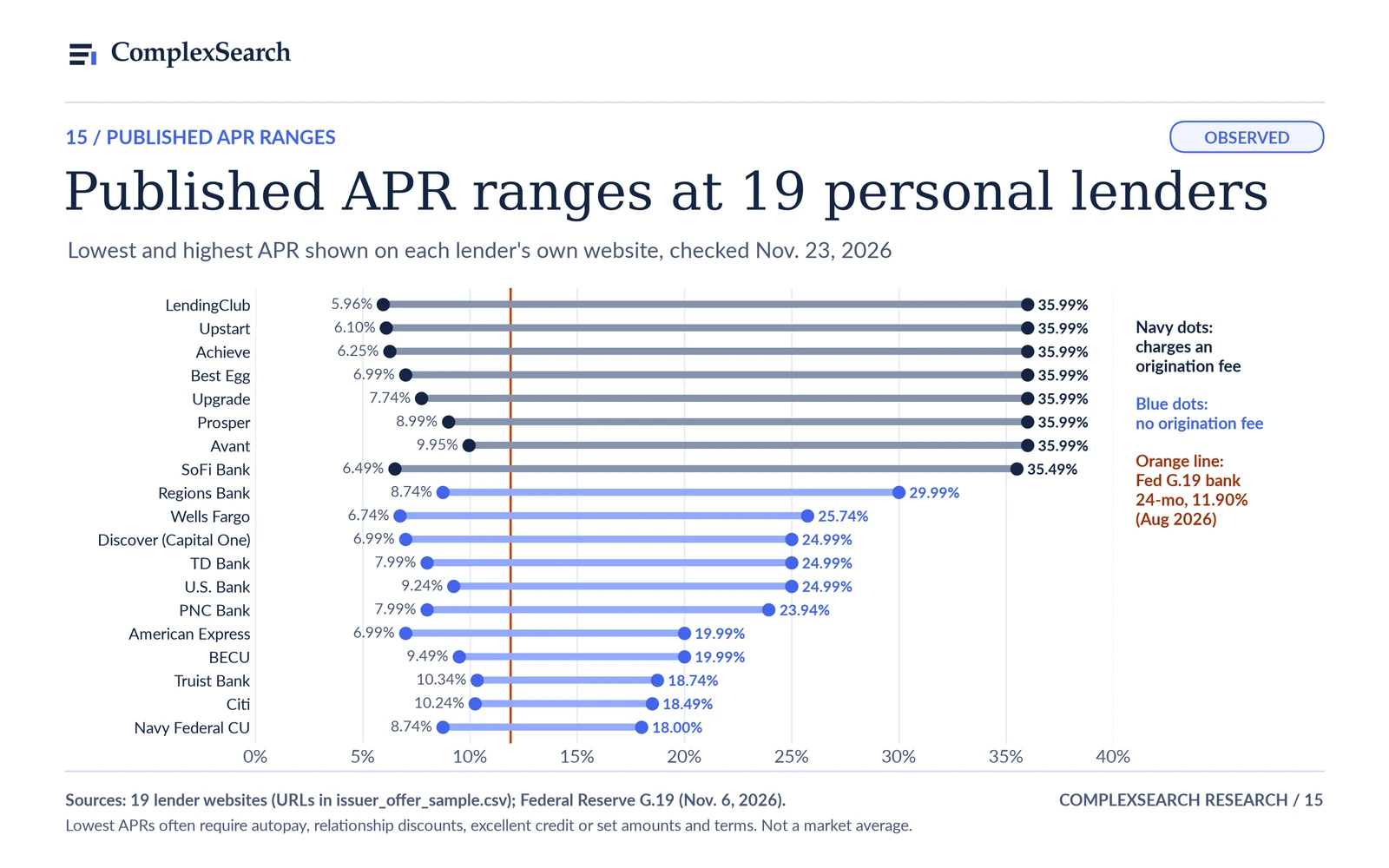
These are advertised minimums and maximums, not rates borrowers typically receive.
Source: Issuer disclosures listed in the lender sample · Direct link
ComplexSearch read the APR range, origination fee, loan amounts and terms on each lender's own personal loan page on November 23, 2026. No aggregator rate was used.
| Statistic (n = 19) | Published minimum APR | Published maximum APR |
|---|---|---|
| Lowest | 5.96% | 18.00% |
| Median | 7.99% | 25.74% |
| Highest | 10.34% | 35.99% |
| Lender | Type | APR range | Origination fee | Amounts | Terms (months) | Issuer date |
|---|---|---|---|---|---|---|
| LendingClub | Bank | 5.96%-35.99% | 0%-8% (most) | $1,000-$75,000 | 24-84 | Nov 5, 2026 |
| Upstart | Online | 6.10%-35.99% | May be charged; range not stated | $1,000-$75,000 | 36 or 60 | Sep 2026 rates |
| Achieve | Online | 6.25%-35.99% | 1.99%-9.99% | $5,000-$50,000 | 24-60 | Not shown |
| SoFi | Bank | 6.49%-35.49% | 0%-7% | $5,000-$100,000 | 24-84 | Nov 23, 2026 |
| Wells Fargo | Bank | 6.74%-25.74% | None | $3,000-$100,000 | 12-84 | Oct 7, 2026 |
| Best Egg | Online | 6.99%-35.99% | 0.99%-9.99% | $2,000-$50,000 | 36-60 | Not shown |
| Discover | Bank | 6.99%-24.99% | None | $2,500-$40,000 | 36-84 | Not shown |
| American Express | Bank | 6.99%-19.99% | None | $3,500-$50,000 | 12-60 | Jul 19, 2026 |
| Upgrade | Online | 7.74%-35.99% | 1.85%-9.99% | $1,000-$50,000 | 24-84 | Not shown |
| PNC | Bank | 7.99%-23.94% | None | $5,000-$35,000 | 12-60 | Nov 19, 2026 |
| TD Bank | Bank | 7.99%-24.99% | None | $2,000-$50,000 | 36-60 | Not shown |
| Regions | Bank | 8.74%-29.99% | None | $2,000-$50,000 | 36-60 | "As of today" |
| Navy Federal | Credit union | 8.74%-18.00% | None | $250-$150,000 | Up to 180 | Nov 23, 2026 |
| Prosper | Online | 8.99%-35.99% | 1%-9.99% | $2,000-$50,000 | 24-72 | Not shown |
| U.S. Bank | Bank | 9.24%-24.99% | None | $1,000-$50,000 | 12-84 | Nov 9, 2026 |
| BECU | Credit union | 9.49%-19.99% | None | Up to $50,000 | Up to 84 | Nov 1, 2026 |
| Avant | Online | 9.95%-35.99% | Up to 9.99% (administration fee) | $2,000-$35,000 | 24-60 | Not shown |
| Citi | Bank | 10.24%-18.49% | None | $2,000-$30,000 | 12-60 | Sep 29, 2026 |
| Truist | Bank | 10.34%-18.74% | None stated | $3,500-$50,000 | Not stated | Not shown |
All eight lenders that charge an origination fee publish a maximum APR of 35.49% or 35.99%. The 11 lenders that charge no origination fee publish maximums from 18.00% to 29.99%, with a median of 23.94%. Fee-charging lenders' APRs include the fee, so the two groups' APRs are comparable. Every row in the research materials has the full URL, check date, fee treatment, eligibility limits and the saved page capture.
Most published minimums carry conditions beyond credit. Seven of the 19 say the minimum includes an autopay, relationship or member discount, or requires paying other creditors directly (SoFi, Wells Fargo, Citi, PNC, U.S. Bank, Regions, Upgrade). Seven tie it to a specific amount or term:
- Wells Fargo: at least $10,000 and a 3-year term.
- Citi: a 36- or 48-month term.
- U.S. Bank: $10,000 or more, 12-36 months, a credit score of 800 or higher and a home-improvement purpose.
- Truist: up to a three-year term.
- Regions: a 36-month term and $25,000 or more.
- Achieve: less than $12,000 and a 24-month term.
- BECU: $5,000 or more.
Navy Federal publishes a separate minimum by term: 8.74% up to 36 months and 10.69% for 37 to 60 months (Navy Federal rates).
ComplexSearch scenario: total repayment on matched loans
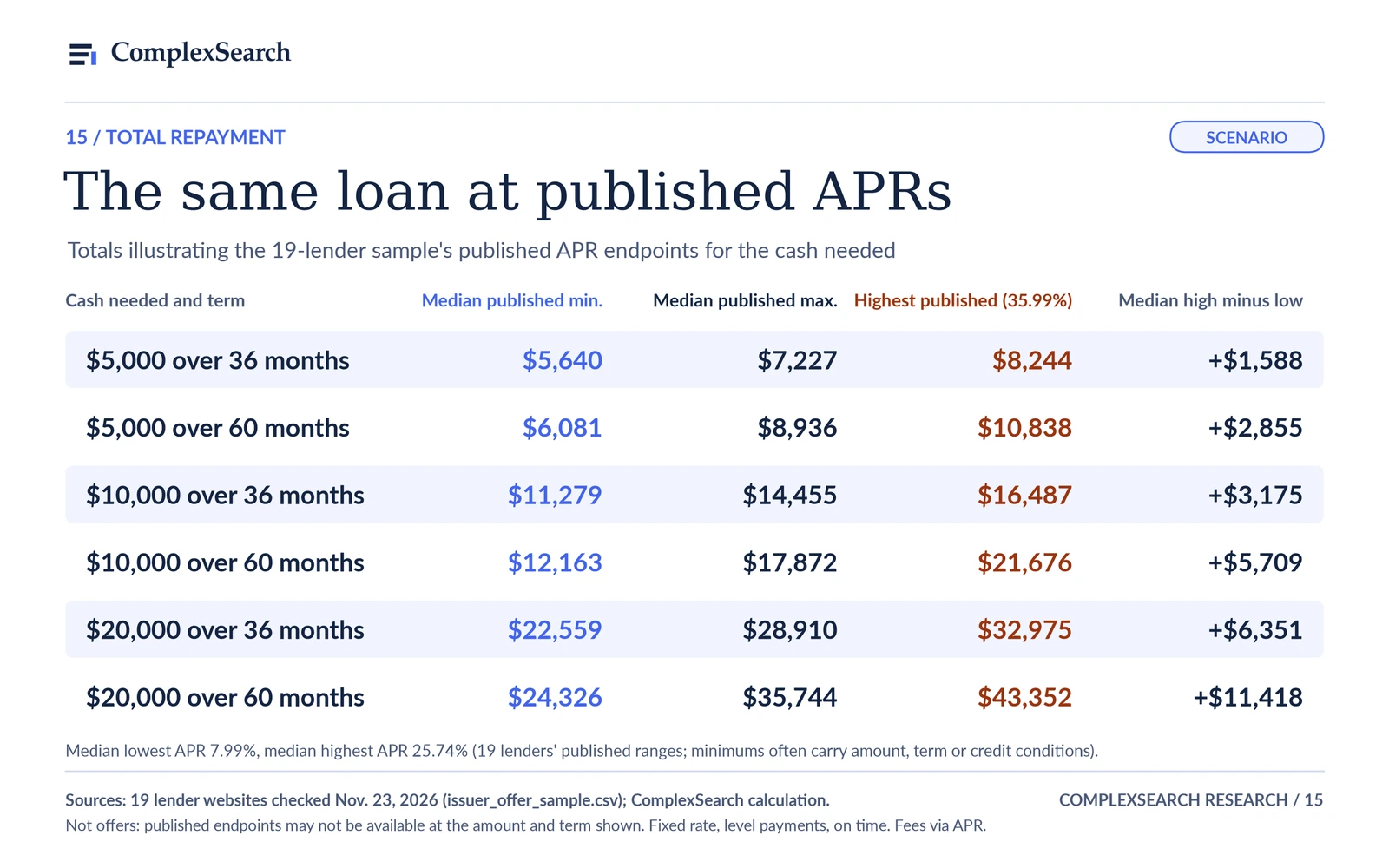
Amounts are illustrations, not approvals or lender quotes.
Source: ComplexSearch matched repayment data · Direct link
This is a ComplexSearch scenario, not observed data, an offer or a forecast. For each lender, amount and term, it applies the published minimum and maximum APR, as published ranges, to the cash the borrower needs. The totals illustrate the sample's published endpoints; a lender's endpoint may not be available at the amount and term shown. The loan has a fixed rate and level monthly payments, all made on time. All 19 lenders' published amount and term ranges include $5,000, $10,000 and $20,000 over 36 and 60 months, but that does not mean their minimum or maximum APR applies at each of those combinations.
For lenders with no origination fee, the result is the total of payments on a loan of that amount. For lenders whose APR includes a fee deducted from proceeds, it is the total on a loan sized so the borrower receives that amount, because APR is the rate on cash received. ComplexSearch checked this against six representative examples published by fee-charging lenders. Five reproduce the stated APR within 0.02 percentage points. Upstart's differs by 0.18 points, likely because its stated payment is rounded (Upgrade, Prosper, LendingClub, Achieve, Upstart; the research materials).
| Cash needed and term | At lowest published minimum (5.96%) | At median published minimum (7.99%) | At median published maximum (25.74%) | At highest published maximum (35.99%) | Median max minus median min |
|---|---|---|---|---|---|
| $5,000, 36 months | $5,473 | $5,640 | $7,227 | $8,244 | +$1,588 |
| $5,000, 60 months | $5,794 | $6,081 | $8,936 | $10,838 | +$2,855 |
| $10,000, 36 months | $10,945 | $11,279 | $14,455 | $16,487 | +$3,175 |
| $10,000, 60 months | $11,589 | $12,163 | $17,872 | $21,676 | +$5,709 |
| $20,000, 36 months | $21,891 | $22,559 | $28,910 | $32,975 | +$6,351 |
| $20,000, 60 months | $23,177 | $24,326 | $35,744 | $43,352 | +$11,418 |
For comparison, $10,000 over 60 months would total $13,316 at the G.19 bank average (11.90%, which is a 24-month-loan rate from the August 2026 survey) and $12,938 at the NCUA credit union average (10.64%, a 36-month rate for December 2025) under the same assumptions. Both are applied outside their own terms for scale only.
Condition check. Only amount and term conditions published with the minimum APR can be checked; credit-score, discount and relationship conditions cannot, so even the filtered figures are published endpoints rather than available rates. Removing lenders whose published minimum does not apply at that amount and term never raises the median-minimum total and lowers it by at most $143. At $10,000 over 60 months, 13 lenders remain and the median-minimum total is $12,091 (7.74%) rather than $12,163 (7.99%). Results for every cell are in the research materials, and per-lender results are in the research materials.
Outlier offers. The 35.99% maximum is shared by seven lenders (LendingClub, Upstart, Achieve, Best Egg, Upgrade, Prosper and Avant), and SoFi's is 35.49%. These eight drive the highest-maximum column. No lender's minimum or maximum APR falls outside Tukey fences (1.5 times the interquartile range), so none is dropped. The lowest minimum, LendingClub's 5.96%, carries no published amount or term condition but "may be available to borrowers with excellent credit."
Origination fees, modeled separately
ComplexSearch scenario. This holds the note rate fixed and varies the fee across the 0% to 9.99% range published by sampled lenders. The borrower needs $10,000 over 60 months at a 16% note rate.
| Origination fee | Fee deducted, same $10,000 loan (cash received) | Fee deducted, loan grossed up to net $10,000: total repayment | Fee added to balance: total repayment | Extra cost vs no fee, deducted / added | APR, deducted / added |
|---|---|---|---|---|---|
| 0% | $10,000 | $14,591 | $14,591 | $0 / $0 | 16.00% / 16.00% |
| 1.85% | $9,815 | $14,866 | $14,861 | $275 / $270 | 16.86% / 16.84% |
| 5% | $9,500 | $15,359 | $15,320 | $768 / $730 | 18.38% / 18.26% |
| 8% | $9,200 | $15,860 | $15,758 | $1,269 / $1,167 | 19.89% / 19.59% |
| 9.99% | $9,001 | $16,210 | $16,048 | $1,619 / $1,458 | 20.94% / 20.45% |
When the fee is deducted and the loan is not enlarged, total repayment stays at $14,591 but the borrower receives up to $999 less. To receive the full $10,000, a deducted fee costs more than the same percentage added to the balance, because the fee is charged on the larger, grossed-up loan. Among sampled lenders that describe the treatment, the fee is deducted from proceeds: SoFi, Upgrade, Best Egg and Avant say so, LendingClub's and Prosper's examples show it, and Upstart says it is "typically" deducted. On a 36-month loan at the same rate, a 5% fee raises the APR from 16.00% to 19.69%, compared with 18.38% at 60 months, because the fee is spread over fewer payments. All 180 combinations of rate, fee, term and treatment are in the research materials.
Sensitivity: total repayment on $10,000 by APR and term
ComplexSearch scenario. Cash received $10,000; fixed rate; level monthly payments.
| APR | 24 months | 36 months | 48 months | 60 months | 84 months |
|---|---|---|---|---|---|
| 6% | $10,637 | $10,952 | $11,273 | $11,600 | $12,271 |
| 8% | $10,855 | $11,281 | $11,718 | $12,166 | $13,092 |
| 12% | $11,298 | $11,957 | $12,640 | $13,347 | $14,828 |
| 16% | $11,751 | $12,657 | $13,603 | $14,591 | $16,684 |
| 20% | $12,215 | $13,379 | $14,607 | $15,896 | $18,653 |
| 24% | $12,689 | $14,124 | $15,649 | $17,261 | $20,728 |
| 28% | $13,173 | $14,891 | $16,729 | $18,681 | $22,899 |
| 35.99% | $14,170 | $16,487 | $18,994 | $21,676 | $27,490 |
Near the sample median minimum (8% to 10%), each additional percentage point of APR adds about $168 to total repayment over 36 months and $291 over 60 months per $10,000. Between 28% and 32%, each point adds about $197 and $369. Rows for 10%, 14%, 18% and 32% are in the research materials.
Methodology
- National series. G.19 series RIFLPBCIPLM24_N.M (finance rate on 24-month personal loans at commercial banks, not seasonally adjusted), from the full G.19 data package. NCUA "Unsecured fixed-rate loan, 36 months," from each quarterly page from 2015 Q1 to 2025 Q4. NY Fed "Other" balance from the 2026:Q3 workbook, Page 3 Data.
- Sample. ComplexSearch selected national banks, large credit unions and online lenders with a public personal loan page. Each page was read on November 23, 2026 and saved. The core sample keeps lenders that publish both a minimum and a maximum APR and accept new applications. APRs are recorded as published, including built-in discounts.
- Scenario. Standard amortization at the published APR applied to the cash needed. Formulas, sample rules and the fee cases are in
the research materials. - Reproduce. Run
python3 the research materials, thenpython3 the research materials.
Limitations
- Published ranges are not offer distributions. Few borrowers qualify for the lowest APR, and lenders do not publish how many receive the highest. The median minimum and median maximum describe the 19 advertised ranges, not what borrowers pay.
- The sample is not random or weighted by lending volume. A different set of lenders would give different medians.
- The three national series measure different things: G.19 is the most common rate at reporting banks on 24-month loans, NCUA is a 36-month average from S&P Global data, and the NY Fed "other" category mixes personal loans with retail cards. They are not directly comparable to each other or to the sample.
- Issuer dates vary. Ten pages show a date from July 19, 2026 (American Express) to November 23, 2026, or say "as of today" (Regions). Upstart's range is based on rates offered in September 2026. Eight pages show no date. All ranges were displayed on the check date.
- Recorded but excluded: LightStream shows a rate grid but says "We are no longer accepting applications." Alliant Credit Union, KeyBank and Happy Money publish only an "as low as" APR. PenFed rendered blank rate fields. Plain fetches of Santander, Citizens, M&T, Huntington, Fifth Third and First Tech pages failed or returned unfilled templates, so they were not used. No APR was recorded or estimated for these lenders, and the sample medians describe only the 19 lenders whose pages could be read; including the unfetched lenders could move them.
- Upstart, Upgrade, Avant, Prosper, Best Egg and Achieve arrange loans made by partner banks. Their own sites are treated as the issuer source for the terms they publish.
- Truist's term range is inferred from its disclosures. Avant's minimum fee and Upstart's fee range are not published.
- The NCUA 2025 Q4 page dates its data extraction "January 15, 2025." This is probably a typo for 2026; the survey date shown is December 26, 2025.
- The scenario leaves out late fees, prepayment, odd first-period interest, state taxes and credit approval. Credit card payoff costs are covered in ComplexSearch Research #14 and are not repeated here.
Download the report
Get the complete report, including charts, methodology and linked sources.
How to cite
ComplexSearch Research. Personal Loan Rates & Borrowing Costs. November 2026.
To include a linked citation on your site, paste this snippet into an HTML block or your editor’s source view.